By Mufy Pachorawala, founder of getAIwork · Last updated: October 4, 2026
Free vs paid AI courses: the content is almost never the difference. The best free material, vendor study paths and the University of Helsinki’s Elements of AI, matches most paid courses. Money buys structure, deadlines, feedback and a credential, and the credential comes from a vendor exam listed at $99 to $100 on October 4, 2026, not from a course.
Listen to this article, about 9 minutes. A synthetic voice reads the article and announces each section title as it begins; tables are read row by row and the questions at the end are left out.
Recorded 4 October 2026 from the article as published that day. Press a chapter to jump there; the highlighted line is what is playing. A play button sits beside every section heading, and once you scroll past this player a bar at the bottom of the screen keeps the controls in reach. Tap or click any sentence to hear the reading start from there.
On this page: the exam fee each vendor lists on its own page as of October 4, 2026, what the FTC alleged about AI training programs sold on an income promise, and the board’s own count of how many of 1,730 live listings ask for advanced skills.
Think you already know this? Five questions, one minute.
Every answer is on this page. Answer from what you know now; the page fills in the rest.
-
1. How does this page describe the free Elements of AI course?
Elements of AI, from the University of Helsinki and MinnaLearn, is free, needs no programming and takes about 30 hours. Source: Elements of AI Read the section
-
2. Which of the things a paid course sells does the table mark as not available free at all?
Content is free and often better, structure is partly free through vendor paths, but nobody free sets you a deadline. That is the purchase worth making when it is your actual gap. Read the section
-
3. What did the FTC allege Ecommerce Empire Builders charged for its training programs?
The FTC’s September 2024 Operation AI Comply announcement alleged training programs costing almost $2,000; these were allegations in a complaint, not findings. Source: FTC press release Read the section
-
4. Why does a vendor certification carry more weight with a stranger than a course completion?
A certification is an exam you can fail, and the vendor lets a third party verify it. A course completion usually cannot be checked, and employers mostly do not try. Read the section
-
5. What fee did AWS list for the Certified AI Practitioner exam on October 4, 2026?
The AWS exam page lists 100 USD, 65 questions and 90 minutes, with an Exam Prep Plan on AWS Skill Builder. Source: AWS exam page Read the section
Key facts
- Official prep for the major vendor AI exams is free. You pay for the exam, not the learning, although Microsoft’s AI-901 certification page listed no learning path yet when checked on October 4, 2026
- Framework documentation is written by the people who built the framework, which is a level of authority no course reseller can match
- A certificate of completion is not a certification. If nobody can fail it, it records attendance rather than ability
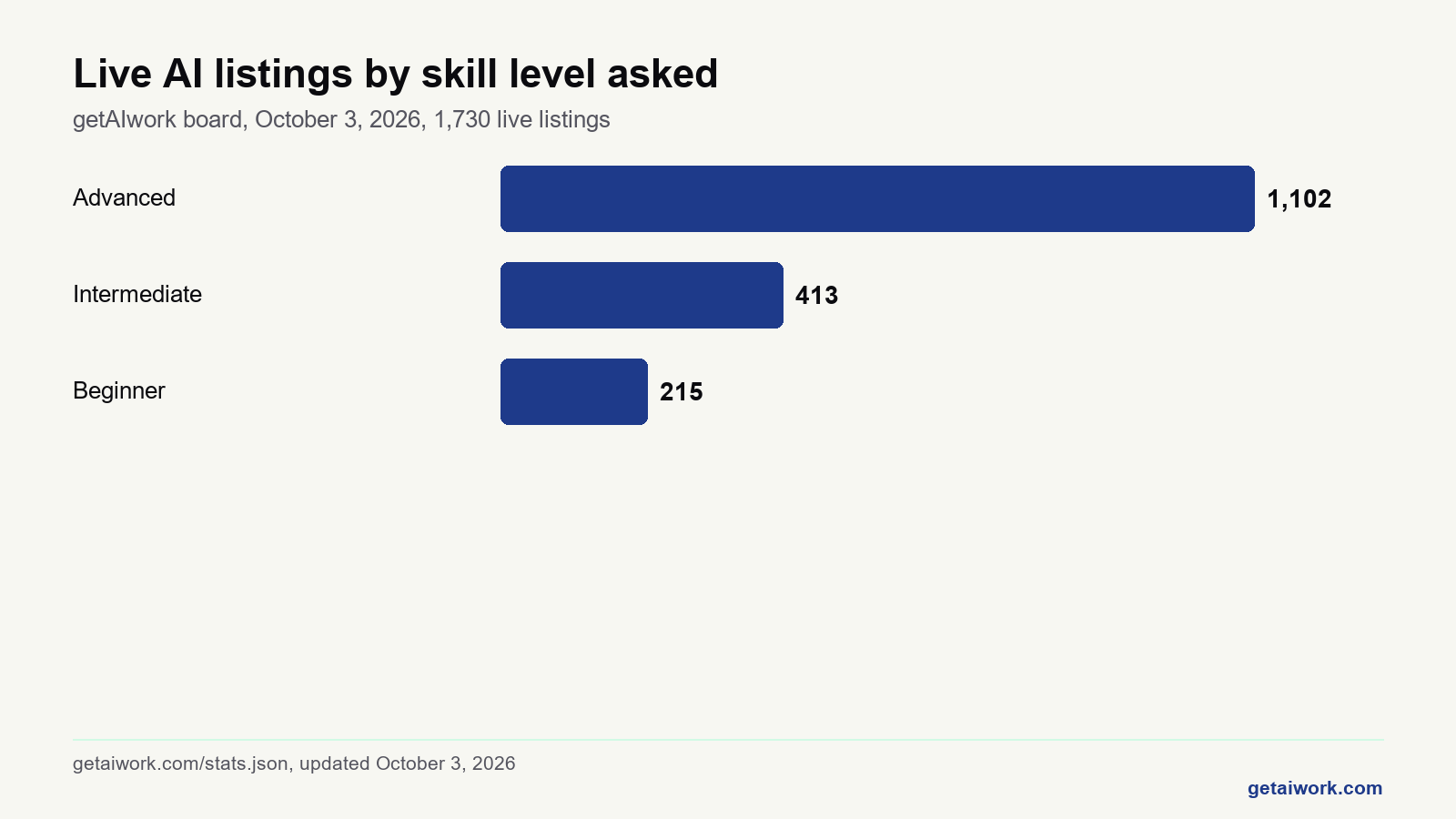
- 1,102 of the 1,730 live listings on the getAIwork board (64%) ask for advanced skills and 215 are marked beginner, as of October 3, 2026, from 44,293 posts screened, and no course clears that on its own
- The most common overspend is paying for content that is free elsewhere while still not getting the structure that was the real problem
- Is there a real quality difference between free and paid AI courses?
- What are you actually buying when you pay for an AI course?
- When is paying for an AI course actually worth it?
- What are the red flags in a paid AI course?
- Do paid courses matter more than certifications?
- What does the free route actually cost in exam fees?
- What is the best free AI learning path to start with?
- FAQ
Is there a real quality difference between free and paid AI courses?
At the top end, no. Vendor certification prep material is mostly free and is written by the vendor whose exam you are sitting. Several complete university courses are published openly, such as Elements of AI from the University of Helsinki and MinnaLearn, which is free, needs no programming and takes about 30 hours. Framework documentation comes from the people who wrote the framework. Nothing sold in an ad on your feed improves on those sources.
What is true is that paid courses are often better packaged. Sequenced, edited, with a clear next step at the end of each module. That is a genuine service and it is worth something. It is just not the same claim as better content, and the marketing deliberately blurs the two.
The middle of the free market is where quality collapses: outdated tutorials, videos describing retired APIs, blog posts confidently explaining a model architecture that was superseded eighteen months ago. Free is not uniformly good, it is uniformly free, and the sorting is your job.

What are you actually buying when you pay for an AI course?
Four things, and it is worth naming them separately because you rarely need all four.
| What you are buying | Available free? | Worth paying for when |
|---|---|---|
| Content | Yes, and often better | Almost never |
| Structure and sequencing | Partly, via vendor learning paths | You browse endlessly and finish nothing |
| Accountability and deadlines | No | You have started three courses and finished none |
| Feedback on your work | Rarely | You cannot tell if your output is any good |
| A verifiable credential | Only via a paid exam | A filter or employer specifically asks for it |
Feedback is the one most underpriced by buyers and most often missing from what they buy. A course with recorded videos and an autograded quiz gives you no feedback at all, so if feedback is your gap, check for a human before you pay. Many “mentorship” tiers turn out to be a group call every fortnight.
What is your actual gap?
Pick the sentence closest to where you are stuck. The answer restates the table above; it is not a recommendation to buy anything.
Nothing here is stored or sent anywhere.
When is paying for an AI course actually worth it?
Four situations, and they are all about you rather than the syllabus.
First, you have tried free material more than once and stalled. Not “found it hard”, stalled: opened it twice and stopped. Paying for a deadline is a legitimate purchase when accountability is the actual bottleneck, and it is cheaper than another six months of intending to.
Second, you need feedback you cannot generate yourself. Early on you cannot tell good work from bad, which is precisely when you most need someone who can. Third, an employer or a filter names a specific credential, in which case you are buying the exam rather than the course. Fourth, someone else is paying, in which case take the good one.
Outside those four, the honest answer is usually that a free path plus a public project would serve you better and leave the money for the exam fee. We lay out that route in how to learn AI.

Take the 2-minute match quiz and filter 1,730 screened AI listings to your skills and level before you spend anything.
Take the 2-minute match quiz →What are the red flags in a paid AI course?
Income claims, first and loudest. Any course quoting what you will earn is describing an outcome it does not control, and the good ones do not do it. This applies to screenshots of earnings, “students are making” phrasing, and testimonials with a figure in them.
Then: guaranteed job placement without a written definition of what counts as placed. Certificates presented as certifications. Prices that expire in the next four hours, permanently. Curricula that name a specific model version but were recorded two years ago, which you can check by looking at the API being used on screen.
Regulators have started naming these. In September 2024 the Federal Trade Commission announced Operation AI Comply, which included a complaint alleging that Ecommerce Empire Builders sold training programs costing almost $2,000 on the promise of an “AI powered Ecommerce Empire” whose profits, the FTC alleged, did not materialise. Those were allegations in a complaint, not findings. In a related case, the FTC said in June 2025 that its action against Ascend Ecom led to an order banning the company and its owners from business opportunity marketing. The pattern in both is the one to watch for: AI offered as the reason a stated income would follow.
A quieter one worth learning to spot: a course whose sales page spends more words on the instructor’s lifestyle than on what you will be able to do at the end. The ratio is diagnostic.
Red flag check for a paid AI course
Tick each one that is true of the sales page in front of you. One tick is reason enough to keep your money.
Ticks are saved on this device only.
Do paid courses matter more than certifications?
They serve different purposes, and only one of them is verifiable by a stranger. An employer can check a vendor certification on the vendor’s site. They generally cannot check a course completion, and mostly do not try.
That does not make courses worthless, it means their value has to be delivered through you rather than through your résumé. A course that genuinely taught you something shows up as capability in an interview. A course that did not shows up as a line nobody asks about.
If your goal is a credential, buy the exam and use the free study path. If your goal is capability, buy the thing that fixes your specific gap. The expensive mistake is buying a course hoping it will do both, which is what most course pages imply and few deliver. Our guides to free AI certifications and what certifications cost cover the credential half.

What does the free route actually cost in exam fees?
If the free route ends in a credential, the only bill is the exam. These are the figures on each vendor’s own page, read on October 4, 2026. Prices change and taxes are extra, so confirm on the page before you book.
| Credential | Free preparation | Exam fee as listed | Source |
|---|---|---|---|
| AWS Certified AI Practitioner | Exam Prep Plan on AWS Skill Builder | $100, 65 questions, 90 minutes | AWS exam page |
| Google Cloud Generative AI Leader | Free learning path on Google Skills | $99, 90 minutes | Google Cloud certification page |
| Microsoft Azure AI Fundamentals, exam AI-901 | Study guide and practice assessment; the certification page said learning paths were not yet available | Set by the country where you sit it; no figure printed on the page | Microsoft Learn AI-901 page |
| Elements of AI | The whole course, about 30 hours | No exam fee; it gives a certificate of completion, not a certification | Elements of AI |
Two things in that table are easy to miss. Microsoft now lists AI-901 for its AI fundamentals certification, updated on April 15, 2026, and the exam page expects some knowledge of Python, so a fundamentals course recorded for the older exam may be teaching to a test that has moved. And Google has at times run offers that waive its $99 fee; whether one is open when you read this is something only the Google page can tell you.
Set against that, a paid course that ends in its own certificate of completion leaves you holding a document no employer can verify, with the exam still to pay for. That is how people end up paying twice, which is a lot of money to spend on a PDF with a gold border.
What is the best free AI learning path to start with?
Pick one vendor study path and finish it. That is the whole recommendation, and the finishing is the hard part. The major clouds each publish free foundational AI prep, and Elements of AI covers the same ground with no vendor attached, both aimed at people who are not yet building. Any of them will do. Choosing the optimal one is a procrastination strategy.
Alongside it, use the tools daily on real work and keep a list of what they get wrong. Then build one small thing and put it somewhere public. That combination, free path plus daily use plus one finished project, outperforms most four-figure courses, and the only thing it costs is the discipline the four-figure course was selling you.
If you finish that and still feel stuck, then pay for something. You will also, by then, know exactly what to pay for, which is the position nobody is in when they buy their first course.
1,730 live AI listings, screened and human-approved, filled ones deleted daily. Free and public, no signup.
See the live board →Frequently asked questions
Are free AI courses as good as paid ones?
At the top end, yes and often better. Vendor certification study paths, published university courses and framework documentation are free and authoritative. Paid courses mainly add sequencing, accountability, feedback and sometimes a credential rather than better content.
What do paid AI courses actually give you?
Structure, deadlines, feedback on your work, and occasionally a credential. Content is rarely the differentiator. Work out which of those four you are missing and buy only that, because paying for all four when you needed one is the usual overspend.
Is a course certificate the same as a certification?
No. A certification is an exam you can fail, issued by a body a third party can check. A certificate of completion records that you watched the material. Listing them together on a resume dilutes the one that took an exam.
How can I tell if a paid AI course is a scam?
Look for income claims, guaranteed placement with no written definition, permanent countdown timers, certificates presented as certifications, and outdated model or API versions visible in the lesson videos. Any income figure at all is the clearest signal to walk away.
Should I pay for a course or for a certification exam?
If you want a verifiable signal, buy the exam and use the free official study path. If you want capability and have stalled on free material more than once, buy the thing that fixes that specific gap. Do not expect one purchase to do both.
What is the best free way to learn AI?
Pick one cloud vendor’s free foundational AI learning path and finish it, use AI tools daily on real work while keeping notes on what they get wrong, and build one small project you put somewhere public. Finishing matters more than which path you choose.
Do employers care which course I took?
Rarely. They generally cannot verify course completions and mostly do not try. A course’s value reaches an employer through what you can do in the interview, not through the line on your resume.

Mufy Pachorawala · Founder, getAIwork
My AI scans thousands of AI-job posts (44,293 screened so far) and I personally approve every listing before it reaches the board. I write these articles by the same rules: pay quoted only as listed, and no income promises. Read our editorial rules.
Related: How to learn AI in 2026 · Free AI certifications · AI certification cost · Are AI certifications worth it?
Finished the page? The same five questions from the top, to see what stuck.
Platform statuses and listed pay change without notice. Pay figures are quoted only as listed by the poster on the date shown and are never a promise of earnings. This page was verified on the date shown and is rechecked on the weekly refresh.