By Mufy Pachorawala, founder of getAIwork · Last updated: August 24, 2026
DataAnnotation.tech is legitimate paid work, run by Surge AI subsidiary Surge Labs, with generalist rates listed at $25 to $30+ per hour as of August 2026. The real risks are practical: a one-attempt qualification test, silent rejections, sudden loss of project access, and week-to-week volume swings. Intake is effectively limited to six English-speaking countries.
Listen to this article, about 9 minutes. A synthetic voice reads the article and announces each section title as it begins; tables are read row by row and the questions at the end are left out.
Recorded 10 October 2026 from the article as published that day. Press a chapter to jump there; the highlighted line is what is playing. A play button sits beside every section heading, and once you scroll past this player a bar at the bottom of the screen keeps the controls in reach. Tap or click any sentence to hear the reading start from there.
On this page: a breakdown of listed hourly rates, a checklist for the Starter Assessment, and documented details from court filings and media profiles.
Think you already know this? Five questions, one minute.
Every answer is on this page. Answer from what you know now; the page fills in the rest.
-
1. Which company operates the DataAnnotation.tech platform?
DataAnnotation is operated by Surge Labs, Inc., as detailed in the September 2025 Forbes profile. Read the section
-
2. What is a common reason for caution regarding DataAnnotation’s payment practices?
A May 2025 class action lawsuit alleges unpaid assessment and training time. Read the section
-
3. What is the listed starting rate for bilingual and language work as of August 2026?
The platform lists language and bilingual work starting at $20+ per hour, though actual earnings depend on project volume. Read the section
-
4. How many times are applicants allowed to take the Starter Assessment?
According to the official FAQ, you can take the assessment only once. Read the section
-
5. What is a primary complaint regarding the platform’s application process?
Applicants frequently face silent rejections where no decision is communicated, as noted in the platform’s FAQ guidelines. Read the section
Key facts
- Pay as listed on dataannotation.tech in August 2026: $25 to $30+ per hour for generalist work, $20+ for language work, $50 to $100+ for coding and licensed professional tracks. Rates are set per project, vary by country, and listed is not earned
- The company itself claims a 2.6% acceptance rate in its April 2026 blog post, which is the single best explanation for why most applicants never hear anything
- Reviews as of August 2026: Trustpilot about 3.1/5 from roughly 1,900 reviews; Indeed 4.1/5 from about 1,680 reviews
- Parent company Surge Labs faces a May 2025 worker classification class action over unpaid assessment and training time. Those are allegations, not court findings
- 630 AI platform programmes are live on the getAIwork board as of August 22, 2026, every one screened and human-approved
What is DataAnnotation.tech and who runs it?
DataAnnotation.tech is a work platform that pays contractors to rate, correct and stress-test AI model output: comparing chatbot answers, writing ideal responses, fact-checking, evaluating code, and similar judgment tasks. It has operated since 2020 and states it has paid out more than $20 million to workers in that time.
The part the website does not tell you: DataAnnotation is operated by Surge Labs, Inc., the company behind Surge AI, one of the largest AI data vendors in the world. A September 2025 Forbes profile of founder Edwin Chen describes DataAnnotation as a wholly owned Surge affiliate that handles worker recruitment, and a May 2025 court filing names Surge Labs as its operator. Neither the DataAnnotation homepage nor its job listings mention Surge by name, and that opacity is a recurring criticism, but the parent is a real, profitable business whose clients reportedly include the major AI labs.
Practical basics, from the platform’s own FAQ as of August 2026: payment is via PayPal, requested on demand and delivered within a few days; work is fully remote; and third-party consensus puts intake at six countries (United States, Canada, United Kingdom, Ireland, Australia, New Zealand). There is no official public country list, which itself tells you how the company communicates.
Is DataAnnotation legit or a scam?
DataAnnotation is legitimate: it verifiably pays real people real money and has done so for six years. It is also opaque and precarious in ways that make many workers feel scammed even though they were paid. Both statements are true at once, and the evidence for each side is worth seeing in one place.
| Evidence it is legitimate | Evidence for caution |
|---|---|
| Six years of documented payouts; the company claims $20M+ paid since 2020 | Ownership not disclosed on the site; Surge connection established by press and court filings |
| Covered as real work by TIME (2024) and Forbes (2025) | Silent rejections: most applicants never receive any decision |
| Indeed rating 4.1/5 from about 1,680 reviews (August 2026) | Trustpilot notably lower at about 3.1/5, with work availability the top complaint |
| Parent company is profitable with major AI labs as reported clients | May 2025 class action alleges unpaid assessment and training time (allegations, not findings) |
| No fees, ever, at any stage | Documented reports of accounts deactivated with earnings still unpaid (TIME, April 2024) |
Our assessment: apply if you are in an eligible country and treat it as variable side income, not a job. The platform pays, the work is real, and the listed rates are among the better generalist rates in the category. Go in knowing that acceptance is rare, communication is minimal, and access can end without notice.
How much does DataAnnotation pay in 2026?
DataAnnotation lists its rates openly, which is more than many rivals do. As of August 2026 the site advertises the following, and every figure is a listed rate, not a promise of volume:
| Track | Listed rate (Aug 2026) | Typical requirement |
|---|---|---|
| Generalist projects | $25 to $30+ per hour | Strong written English, careful instruction-following |
| Language and bilingual work | $20+ per hour | Native-level fluency in two or more languages |
| Coding projects | $50 to $100+ per hour | Working knowledge of Python, JavaScript or similar |
| STEM and professional tracks | $50 to $100+ per hour | Advanced degree or licensed credential, or long experience |
What people actually take home depends on volume. A 2024 TIME profile documented a worker earning $20 to $25 per hour and roughly $400 to $500 in a part-time week, sustained over two years, with coding tasks paying around $40. Community reports from 2026 describe effective rates a few dollars under the listed ones once you count unpaid qualification tests and slow weeks. The number worth tracking is your own effective rate: money received divided by every hour spent, including guideline reading and dry spells.
Answer 6 questions and we match you against 630 live platform programmes on the getAIwork board, by skill, level and country.
Take the 2-minute match quiz →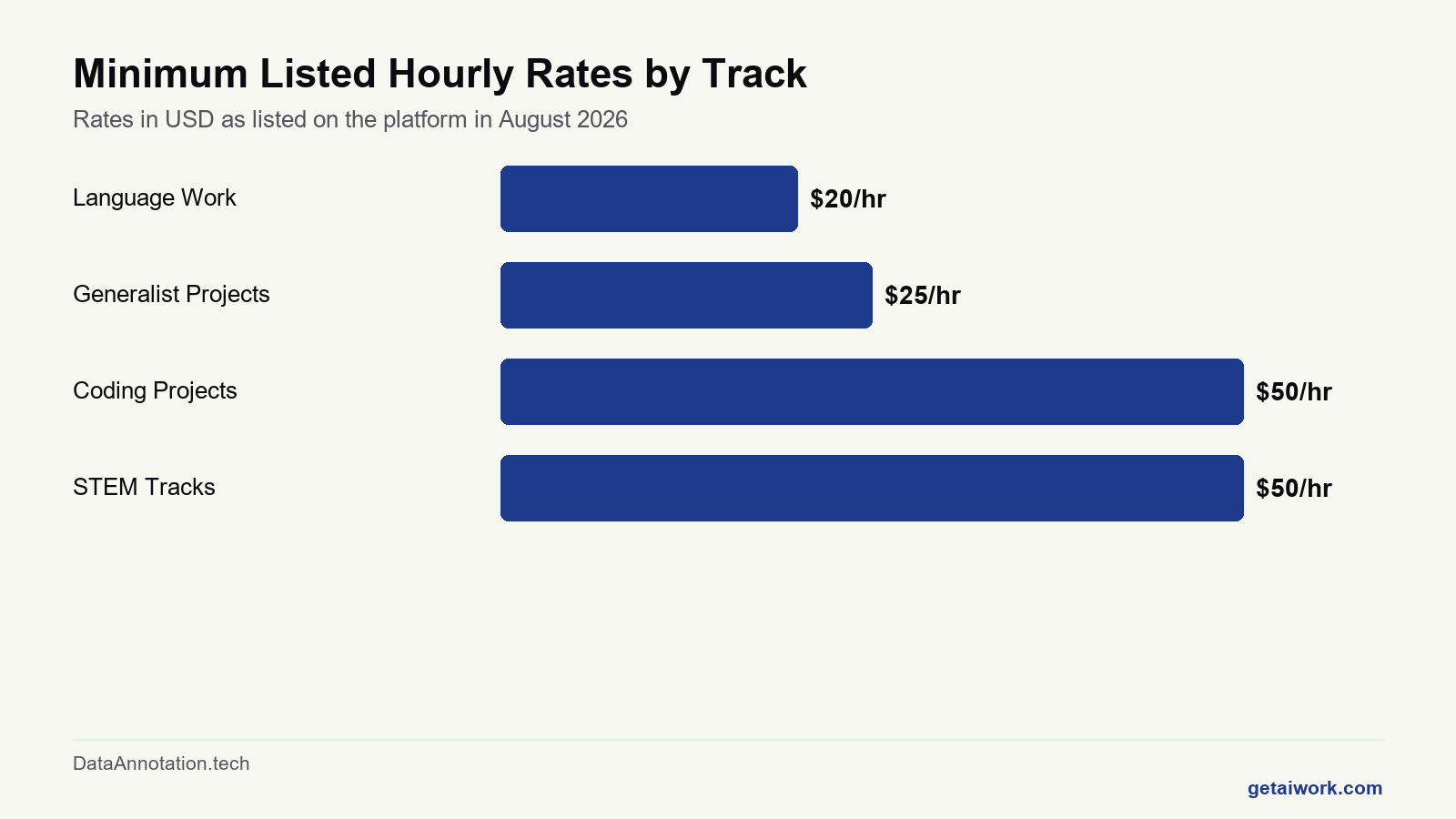
How do the application and Starter Assessment work?
The application is the assessment. You sign up, confirm eligibility, and take an unpaid Starter Assessment of roughly an hour (longer for specialist tracks): comparing model responses, short writing and editing, and track-specific questions. The official FAQ is unambiguous on the two facts that matter most: results are promised “within a few days,” and you can take the assessment only once. No retakes, no second chances, no second accounts.
Because that one attempt decides everything, the preparation that experienced workers recommend is simple but non-negotiable:
- Block out two undisturbed hours. Successful applicants consistently report spending well beyond the listed hour.
- Read every instruction twice before answering. Most rejections are believed to be instruction-following failures, not ability failures.
- Explain your reasoning in comparison tasks. Detailed, specific justifications are the strongest signal the graders are looking for.
- Never use AI tools to write your answers. This is explicitly against the rules and is widely reported as an instant, silent rejection.
- Skip the VPN. Location masking is repeatedly cited in the community as a ban trigger.

Starter Assessment Preparation Checklist
Increase your chances on your single assessment attempt by verifying these preparation steps.
Ticks are saved on this device only.
What are the biggest complaints?
Four complaints dominate every review channel, and none of them is about being paid incorrectly for completed work.
1. Silence after applying. The FAQ promises a decision within days; aggregated applicant reports show a median of one to four weeks and a long tail who never hear anything. Rejections are not sent at all.
2. The empty dashboard. Work arrives in waves tied to client projects. The company’s own blog concedes some weeks offer thirty billable hours and others twelve; community trackers describe typical dry spells of three to seven days, and dashboards that stay empty for weeks are widely read as a quiet removal. The platform acknowledges that low quality scores can end project access without a formal notice.
3. Deactivation without explanation. TIME documented accounts closed with earnings still unpaid in 2024, and similar reports have continued since. There is no published appeal process.
4. Unpaid assessment time. The Starter Assessment and project qualifiers are unpaid, and a May 2025 class action against Surge Labs alleges that this unpaid time, plus task time limits, amounts to wage violations. The company calls the suit meritless; no ruling had been reported as of August 2026.
The workers who sustain this qualify on two or three platforms and concentrate hours wherever volume currently is. See what is live for your profile.
Find your match in 2 minutes →The impersonation scams that borrow its name
Because DataAnnotation is famous for accepting beginners, it is heavily impersonated. Through 2026, a recurring scam pattern (often using a fake recruiter persona) contacts people by LinkedIn message or text, offers guaranteed DataAnnotation work, then routes victims to Google Forms, Telegram chats or lookalike domains and eventually asks for a fee or banking details.
The real platform breaks every one of those patterns: it recruits only through its own site, never messages you first, never uses chat apps for hiring, never guarantees income, and never charges anything at any stage. If any of those five things happens, it is not DataAnnotation, whatever the logo says. Every listing that reaches the getAIwork board is screened against exactly these patterns before a human approves it.
Skip the impersonators. Every listing on the board links to the platform’s real domain and passed a human check.
See the live board →Frequently asked questions
Is DataAnnotation.tech a scam?
No. It has paid workers since 2020, is operated by Surge AI subsidiary Surge Labs, and was covered as legitimate work by TIME and Forbes. The recurring problems are silent rejections, variable work volume and unexplained deactivations, not non-payment for approved work.
Who owns DataAnnotation.tech?
Surge Labs, Inc., the company behind Surge AI, according to a 2025 court filing and Forbes reporting. The DataAnnotation website does not mention Surge, which is why the connection surprises many applicants.
Which countries can apply to DataAnnotation?
There is no official public list. Third-party consensus in 2026 puts intake at the United States, Canada, the United Kingdom, Ireland, Australia and New Zealand. Reports claiming much wider eligibility conflict with the platform’s PayPal-based payment setup and are unreliable.
How does DataAnnotation pay you?
Via PayPal. You request a withdrawal from your dashboard and the FAQ says deposits arrive within a few days. Task earnings typically become withdrawable about a week after submission, and there is no published minimum cash-out.
Can you retake the Starter Assessment?
No. The official FAQ states you can take it only once, with no retakes. Creating a second account to try again conflicts with the platform’s terms and risks losing both accounts, so treat the single attempt seriously.
How long does it take to hear back after the assessment?
The FAQ says a few days; real reports range from under 24 hours to several weeks, and a large share of applicants never hear back at all because rejections are silent. Our guide to DataAnnotation response times covers the full distribution.
Do you pay taxes on DataAnnotation earnings?
You work as an independent contractor, so earnings are untaxed at source and reporting them is your responsibility. US workers above the reporting threshold receive contractor tax paperwork. Rules differ by country, so check with a tax professional where you live.
Why is my DataAnnotation dashboard empty?
Usually because a client project ended and the shared task pool emptied for everyone in your queue. Dry spells of three to seven days are commonly reported and normal. A dashboard that stays empty for several weeks, with support not responding, is widely read as loss of access.

Mufy Pachorawala · Founder, getAIwork
My AI scans thousands of AI-job posts (38,434 screened so far) and I personally approve every listing before it reaches the board. I write these articles by the same rules: pay quoted only as listed, and no income promises. Read our editorial rules.
Related: DataAnnotation response times · Data annotation jobs compared · Get paid to train AI · AI jobs in 2026 · Live AI job market statistics · Taxes and 1099s on AI task work · Outlier account deactivated? · AI rater jobs · Surge AI review · How to pass the DataAnnotation starter assessment · Outlier vs DataAnnotation
Finished the page? The same five questions from the top, to see what stuck.
Platform statuses and listed pay change without notice. Pay figures are quoted only as listed by the poster on the date shown and are never a promise of earnings. This page was verified on the date shown and is rechecked on the weekly refresh.