
Of the 1,704 AI jobs live on the getAIwork board on 27 September 2026, 621 (36.4%) were tagged remote. For anyone searching AI jobs remote, that share is 80.7% on AI training platforms but only 8.0% on salaried roles, and remote rarely means worldwide: most platforms still restrict which countries they accept.
Listen to this article, about 12 minutes. A synthetic voice reads the article and announces each section title as it begins; tables are read row by row and the questions at the end are left out.
Recorded 27 September 2026 from the article as published that day. Press a chapter to jump there; the highlighted line is what is playing. A play button sits beside every section heading, and once you scroll past this player a bar at the bottom of the screen keeps the controls in reach. Tap or click any sentence to hear the reading start from there.
On this page: the remote share of all 1,704 live board listings on 27 September 2026 split by type, level and field, the three posters behind 80.8% of remote listings, four platforms’ own country rules, and 25 dated reviews read.
Think you already know this? Five questions, one minute.
Every answer is on this page. Answer from what you know now; the page fills in the rest.
-
1. How many of the 1,704 live listings on the getAIwork board were tagged remote on 27 September 2026?
621 were tagged remote and 1,083 were tied to a place, per the board’s own stats.json for 27 September 2026. Read the section
-
2. Which listing type had the highest remote share on the board on 27 September 2026?
505 of 626 AI training platform listings were remote, 80.7%, against 8.0% of salaried roles, counted from the live getAIwork board that morning. Read the section
-
3. What does Outlier’s working location policy, effective 15 July 2026, say about VPNs?
The Outlier working location policy limits work to the Primary Location set at onboarding and does not permit a VPN to mask presence in a restricted country. Read the section
-
4. What share of the 621 remote listings came from micro1, Mercor and Neon combined?
Those three posted 502 of the 621 remote listings, 80.8%, counted from the live getAIwork board on 27 September 2026. Read the section
-
5. Roughly how many task scam reports did the FTC count in the first half of 2024?
The FTC data spotlight counted about 20,000 task scam reports in the first half of 2024, up from about 5,000 in all of 2023. Read the section
How many AI jobs are remote right now?
Every figure on this page comes from the getAIwork work board, which I run and which screens AI work listings by hand every day. On 27 September 2026 the board held 1,704 live listings: 621 tagged remote and 1,083 tied to a country or a city. Three days earlier, on 24 September, it was 607 remote out of 1,654, so the share has held between 36% and 37% rather than lurching. The daily totals are published openly on the board statistics page, and the wider picture sits in our AI job market statistics.
For scale, the Bureau of Labor Statistics found that 22.6% of US workers teleworked in March 2026. That counts people who worked from home for at least part of the time, not job adverts, so the two numbers measure different things. Still, a remote share above a third is high for any category of listing, and it is high for one specific reason, which the next table shows.
Which kinds of AI work are most often remote?
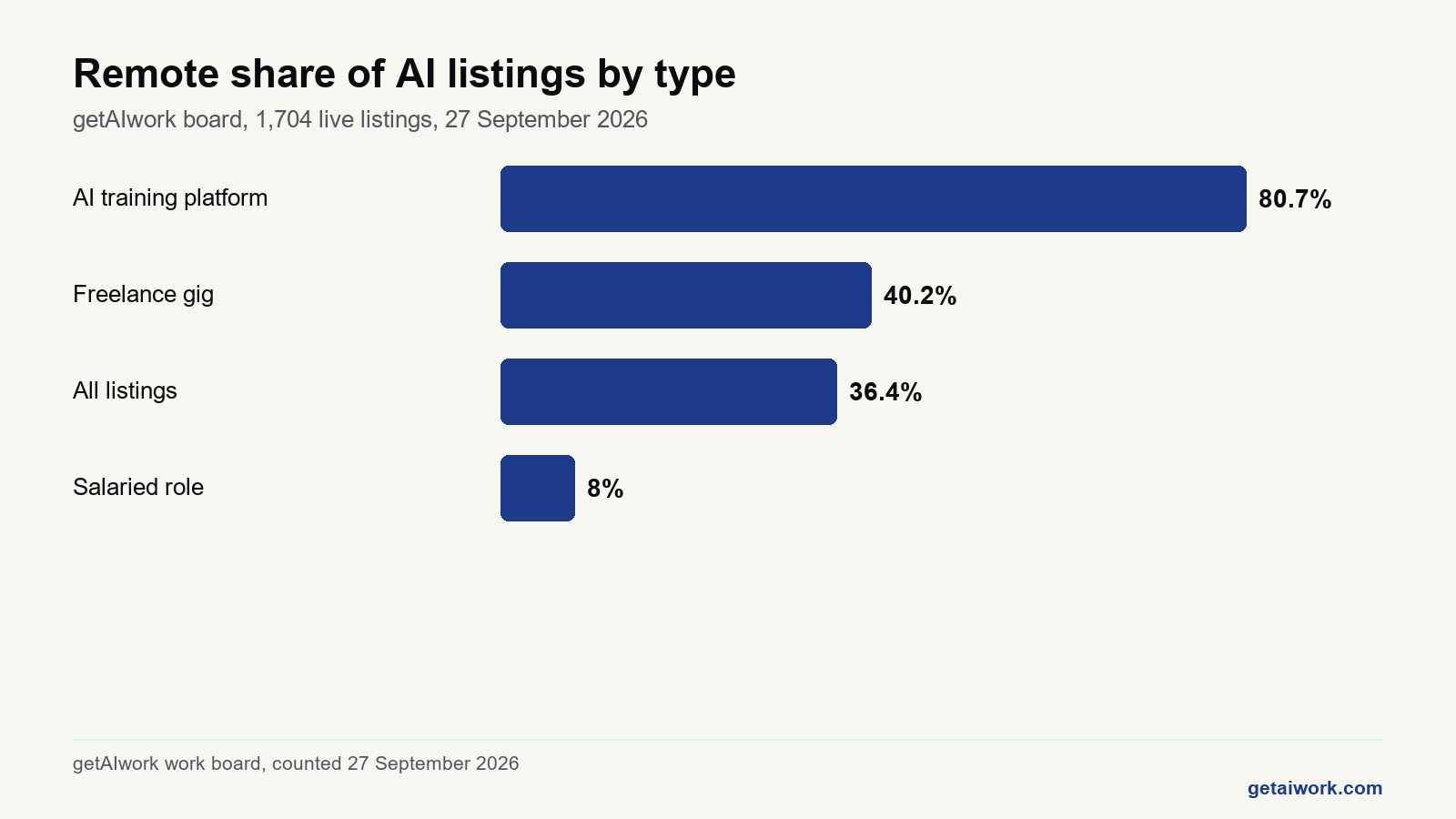
The board sorts every listing into one of three types. Here is how many of each were remote on 27 September 2026, counted from the live board that morning.
| Listing type | Live listings | Tagged remote | Remote share |
|---|---|---|---|
| AI training platform | 626 | 505 | 80.7% |
| Freelance gig | 92 | 37 | 40.2% |
| Part time or junior salaried role | 986 | 79 | 8.0% |
| All listings | 1,704 | 621 | 36.4% |
So the remote AI job is overwhelmingly a platform job: rating, writing, checking and correcting model output from home, paid per task or per hour and organised by project. Salaried AI roles are the opposite. Of 986 on the board, 79 were remote. By field, licensed professionals such as lawyers and doctors saw the highest remote share at 75.8% (119 of 157), STEM sat at 51.5%, language work at 49.0%, generalist writing at 45.5%, and coding at just 16.7% (130 of 780). The engineering world, it seems, has rediscovered the office kitchen.

Are remote AI jobs open to beginners?
More than the headline suggests. Of 262 live listings the board marked beginner level, 126 were remote, or 48.1%. Intermediate listings came out almost identical at 48.3%, while advanced listings dropped to 29.1%, because most of the senior roles are salaried engineering jobs with an office attached.
The catch is where those 126 beginner remote listings live: 110 are on AI training platforms, 14 are freelance gigs and 2 are salaried roles. A beginner remote AI job, on the evidence of this board, is almost always platform work, which means an assessment first, work that arrives by project, and no promise of hours. Our guides to AI jobs with no experience and AI training jobs with no experience cover what those assessments look like. If you would rather be matched to what is live for your background than scroll 621 listings, the six question match quiz does that from the same board data.
Does a remote listing mean anyone in any country can apply?
No, and this is where most remote job boards go quiet. Only 8 of the 621 remote listings named a country or region in the title, such as a LATAM or Brazil tag. The other 613 left the location rule to the platform’s own policy, which you only meet once you apply. Here is what four platforms said when we read their own pages on 27 September 2026.
| Platform | What its own page says about location | Source, read 27 Sep 2026 |
|---|---|---|
| Outlier | You may work only from the Primary Location set at onboarding; using a VPN to mask presence in a restricted country is not permitted. Policy effective 15 July 2026. | Outlier working location policy |
| micro1 | Cannot hire residents of 20 listed countries, including China, Russia, Ukraine, Iran and Venezuela. Individual postings add their own region, for example a Europe based data role. | micro1 experts page, sample posting |
| Mercor | Engages contractors only in countries on its supported regions list. India, the US and the UK were on it. | Mercor supported countries |
| DataAnnotation | Its FAQ names no country list. It does say it charges no signup fees and will never ask you for money. | DataAnnotation FAQ |
One gap we could not close: Outlier’s policy page did not display its full country list when we read it. A list returned by search the same day named Argentina, Australia, Canada, Mexico, New Zealand, Puerto Rico, the UK and the US, without India, but we could not confirm that list on the page itself, so treat it as unverified. The board keeps its own country verdicts for this reason: 289 of them across 8 platforms, last verified on 20 August 2026, per stats.json.
For readers in India the onsite side matters too. Of the 1,083 listings tied to a place, 344 were in the US, 262 in the UK, 214 in Germany and 90 in India, so an onsite role is not automatically out of reach.

Who is actually posting the remote listings?
Three posters account for 502 of the 621 remote listings, or 80.8%: micro1 with 280, Mercor with 172 and Neon with 50. The long tail of 119 comes from dozens of companies with one to eight listings each. That changes how to read the number. A search that returns hundreds of remote AI jobs is mostly returning hundreds of role pages from two intake pipelines, and one application to micro1 or Mercor puts you in the pool for many of them. Our Mercor and micro1 comparison covers how the two differ once you are in.
Remote listings were also more likely to state pay. 552 of the 621 carried a pay figure, 88.9%, against 1,040 of all 1,704 listings, 61.0%. The board quotes those figures exactly as each poster lists them, on the date shown, and they describe what a poster says it pays if you are accepted, not what anyone is guaranteed to receive. The live platform statuses are tracked daily on our page of AI training platforms hiring now.
What do applicants to the two biggest remote posters report?
Because two companies post most of the remote work, we read their public reviews on Trustpilot on 27 September 2026: the 20 most recent on micro1’s page and all 5 on Mercor’s, 25 in total. These are reviews, labelled as such, and none of them is a statement of what either platform pays.
On micro1’s Trustpilot page, which showed a score of 4.7 across about 10,500 reviews, 19 of the 20 newest were four or five stars, and most described the AI interview itself, written within a day of taking it, by reviewers in India, Nigeria, Kenya, Germany, Canada and elsewhere. The one one star review, from Colombia, reported being blocked at the email step of onboarding. What reviews written on interview day cannot tell you is whether paid work followed.
On Mercor’s Trustpilot page the picture was the reverse and the sample far smaller. Four one star reviews dated July and August 2026 came from applicants in the US and UK: one, dated 26 August 2026, alleges removal from a project after hours of work without clear guidance on pay; another, dated 15 July 2026, alleges 32 hours of unpaid training before removal. We could not verify either account. The single five star review, from May 2024, praised the vetting and follow up.
Where the accounts meet the official line: both platforms describe work as project based, and the reviews agree that getting in and getting work are separate steps. Where they do not: no remote listing we read mentioned unpaid onboarding time, which is exactly what the negative accounts describe.
How do you spot a fake remote AI job?
Remote work is where the fakes cluster, because nobody expects to meet anyone. The Federal Trade Commission found no task scams in its 2020 sample of job scam reports, about 5,000 in 2023 and about 20,000 in the first half of 2024 alone. Reported losses to job scams topped $220 million in those six months, and crypto was the currency of choice. The script is always the same: simple tasks like rating product images, a dashboard of growing commissions, then a request to deposit money to unlock the next batch.
Which is why a Telegram recruiter hiring AI trainers for OpenAI deserves exactly the attention you would give a prince with a shipping problem. OpenAI’s real openings sit on its own careers board. A real platform pays you; if a job asks you to pay it, to unlock tasks, buy a kit or clear a withdrawal, it is not a job.
What should you check before applying to a remote AI listing?
The checklist below restates what the board’s own listing cards show and what the platforms’ own pages say, in the order worth checking. Tick through it once per platform, not once per listing, since most remote listings share a pipeline. The free board is public and needs no signup, and filtering it by level or skill takes a minute. If you want the remote listings that fit your background sorted for you, the getAIwork match quiz reads the same live data.
Before you apply to a remote AI listing
Seven checks drawn from what the board’s listing cards show and what the platforms’ own pages say. Run them once per platform, since most remote listings share a pipeline.
Ticks are saved on this device only. Passing these checks is not a promise of work or pay from any platform.
Frequently asked questions
Are remote AI jobs full time?
Rarely. On 27 September 2026 only 79 of the 621 remote listings on the getAIwork board were salaried roles. The rest were AI training platform work or freelance gigs, organised by project with no set hours.
Can I work remote AI jobs from India?
It depends on the platform, not the listing. Mercor’s supported countries list included India when read on 27 September 2026, micro1’s excluded list does not name India, and a search result list of Outlier countries did not include India, which we could not confirm on Outlier’s page.
Do remote AI jobs list their pay?
More often than other listings. 552 of 621 remote listings on the board stated a pay figure on 27 September 2026, against 61.0% of all listings. Figures are quoted as each poster lists them, rates change, and nothing is guaranteed.
Can I use a VPN to take a remote AI job from another country?
Outlier’s working location policy, effective 15 July 2026, says using a VPN to mask your presence in a restricted country is not permitted, and you may work only from your registered Primary Location.
How often do the remote numbers change?
Daily. The board had 607 remote listings on 24 September 2026, 619 on 25 September and 621 on 27 September. The current count is always on the getAIwork statistics page.
Is the getAIwork board free to use?
Yes. The work board at getaiwork.com/board is free and public, with no signup needed to browse or filter it.
Finished the page? The same five questions from the top, to see what stuck.
Platform statuses and listed pay change without notice. Pay figures are quoted only as listed by the poster on the date shown and are never a promise of earnings. This page was verified on the date shown and is rechecked on the weekly refresh.