
OpenAI careers, read from the company’s own Ashby job board on 26 September 2026, list 830 open roles. All but one are salaried staff jobs, 580 of them sit in San Francisco, and 24 are tagged remote. Not one is an AI trainer, annotator or rater post, and no internship or entry level title appears anywhere.
Listen to this article, about 14 minutes. A synthetic voice reads the article and announces each section title as it begins; tables are read row by row and the questions at the end are left out.
Recorded 26 September 2026 from the article as published that day. Press a chapter to jump there; the highlighted line is what is playing. A play button sits beside every section heading, and once you scroll past this player a bar at the bottom of the screen keeps the controls in reach. Tap or click any sentence to hear the reading start from there.
On this page: every one of the 830 roles on OpenAI’s own board counted on 26 September 2026, the pay bands 664 of them state, the four public accounts I read about its hiring, and the six checks to run before you answer a recruiter.
Think you already know this? Five questions, one minute.
Every answer is on this page. Answer from what you know now; the page fills in the rest.
-
1. Which part of OpenAI had the most open postings on 26 September 2026?
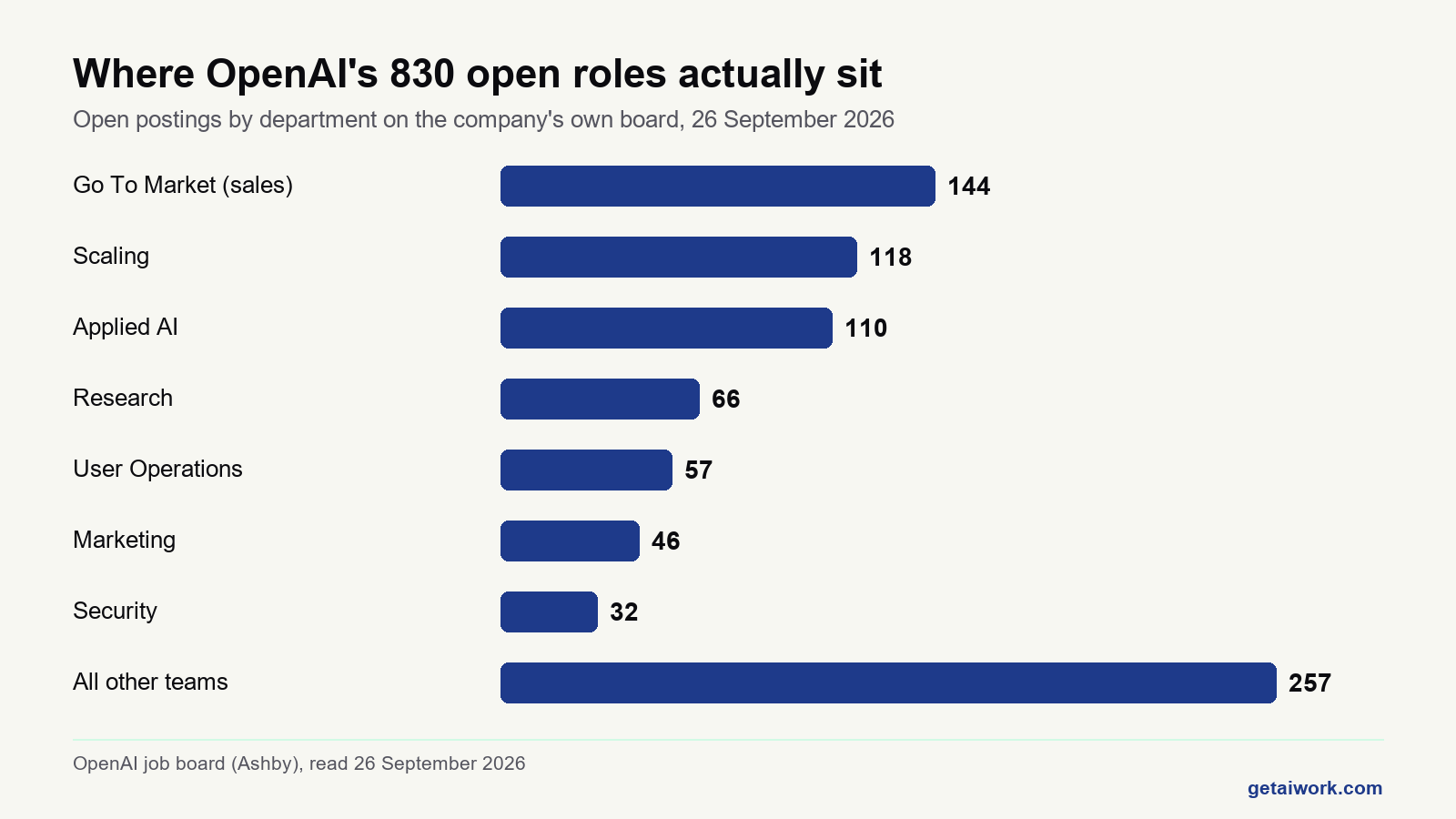
Counted from OpenAI’s own Ashby board on 26 September 2026: Go To Market 144 postings, Scaling 118, Applied AI 110 and Research 66, so sales openings outnumbered research openings by more than two to one. Read the section
-
2. How many of the 830 postings were tagged remote on that day?
24 were tagged remote, 514 hybrid, 31 on site and 261 carried no tag. 289 postings on the board repeated the same line about a hybrid model of three days in the office per week. Read the section
-
3. What was the lowest annual band stated anywhere on the board that day?
The lowest of the 659 US dollar bands on OpenAI’s board on 26 September 2026 was $99,000 to $110,000 for a Corporate Security GSOC Operator. The median band floor was $252,000. These are figures as listed on that date, not offers. Read the section
-
4. How many of the 830 job titles contained trainer, annotator or rater?
None. Three roles carried Human Data in the title, including a Program Manager, Human Data listed at $207,000 to $230,000, and all three run the programme rather than do the labelling work inside it. Read the section
-
5. What is the first check on a message claiming to recruit for OpenAI?
If the role is not on OpenAI’s own board it is not an OpenAI role. The US Federal Trade Commission reports that job scam reports tripled between 2020 and 2024, with reported losses rising from $90 million to $501 million. Read the section
What does OpenAI’s own job board list today?
OpenAI runs its hiring through Ashby and leaves the board public, so what follows is a count rather than an impression. On 26 September 2026 the OpenAI job board carried 830 listed postings, 829 of them salaried full time roles. Exactly one is a contract role, a Recruiting Coordinator in San Francisco posted on 28 August 2026, so the only contract job on the board is the one that helps with hiring.
The department split is where the popular picture of an AI lab falls apart. Go To Market, the sales organisation, has 144 open postings. Scaling, which builds and runs the data centres, has 118, and Applied AI has 110. Research has 66, about eight percent of the board, so sales openings outnumber research openings by more than two to one. User Operations has 57, Marketing 46, Security 32, and the remaining 257 sit across roughly thirty smaller teams.
Geography is narrower still. 580 of the 830 postings, seventy percent, are in San Francisco, then Singapore with 33, Tokyo and London with 24 each and Dublin with 23. The same shape shows on Anthropic’s board, counted the day before this one.
Freshness cuts both ways: 84 postings went up in the week to 26 September and 296 in the last thirty days, but 137 are more than 180 days old and the oldest still listed dates to 25 May 2023.
Does OpenAI hire remote, and what is the office rule?
Mostly it does not, and the board says so in its own words. Of the 830 postings, 514 are tagged hybrid, 31 on site, 24 remote, and 261 carry no workplace tag at all. 289 postings contain the same sentence: “We use a hybrid work model of 3 days in the office per week.” In 211 of them that sentence continues with an offer of relocation assistance, which is a polite way of saying the job expects you to move.
Search the location field instead and 35 postings mention Remote, 24 of them as US Remote. These are not a general remote pool: they are infrastructure security, power trading, land development and data centre roles, with listed floors from $125,000 to $401,000 on the day. The remote door at OpenAI is real, and it opens for people who have spent a decade near electrical substations.
India gets ten postings: four in Delhi, three in Mumbai, two Bangalore remote and one India remote. All ten are commercial or solutions work, and none states pay.

What does OpenAI pay, as listed on its own postings?
664 of the 830 postings state a pay band, which is more openness than most employers manage. Of the 659 quoted in US dollars, the median band floor is $252,000 and 551 floors sit at $200,000 or above. Only nine fall below $150,000 and exactly one is below $120,000, a Corporate Security GSOC Operator at $99,000 to $110,000, which is the cheapest role on the entire board. The top is $510,000 to $536,000 for an engineering manager in Applied AI. Every figure here is as listed by OpenAI on 26 September 2026, and a listed band is a band, not an offer.
| Department | Open postings | Lowest listed band floor |
|---|---|---|
| Go To Market (sales) | 144 | $144,000 |
| Scaling (data centres and supply) | 118 | $123,000 |
| Applied AI | 110 | $180,000 |
| Research | 66 | $157,000 |
| User Operations | 57 | $162,000 |
| Marketing | 46 | $198,000 |
| Security | 32 | $129,600 |
| Finance | 29 | $158,000 |
| All other teams, about thirty of them | 257 | $99,000 |
Is there an entry level or AI trainer route at OpenAI?
No, and this is the most useful thing the board tells anyone who arrived hoping otherwise. Searching all 830 titles returns zero results for trainer, zero for annotator, zero for rater and zero for labeler. Three roles carry Human Data in the title: a Program Manager, Human Data at $207,000 to $230,000 posted on 19 August 2026, a research programme manager for human data campaigns at $239,000 to $328,000, and a research software engineer for human data at $295,000 to $385,000. All three are in San Francisco, and all three run the human data programme rather than do the work inside it.
There is no intern, apprentice, residency or entry level title anywhere on the board either. The gate is experience rather than education: 491 postings name a years figure and 395 of those ask for five years or more, while 21 ask for two or fewer, and only ten of the 830 postings name a bachelor’s degree at all.
Which means the certificate industry has it backwards. OpenAI is barely asking what you studied and is asking hard about what you have shipped, so a course selling a credential that appears in none of 830 postings is solving a problem this board does not have. To see which openings match what you can actually show today, the two minute match quiz at getaiwork.com asks about your background and points you at the ones that fit it.
What do people who looked closely at OpenAI hiring report?
I read four public accounts for this section, three on Hacker News and one on OpenAI’s own developer forum. They are testimony rather than evidence, and they describe things a job board cannot.
The most detailed comes from a sales recruiter posting as seem_2211 on 26 May 2026, who reviewed every Member of GTM Staff profile they could find on LinkedIn, 607 of them, and classified the 390 based in the United States. 43 percent were quota carrying account executives, and the hires came from AWS, Google and Salesforce rather than the traditional enterprise software names, none of which reached their top thirty sources. They published the method and its weakness, that LinkedIn over represents people who keep a profile current, and the full report is free to read. That count agrees with the board: sales is the largest block of open roles.
A commenter posting as abound wrote on 1 October 2024 that while talking with OpenAI recruiters they received calendar invitations carrying model generated images, and interview preparation guides that read as though an older model had written them. A small detail, and it describes a process that is genuine and a little chaotic.
The other two accounts are about approaches that were not OpenAI at all. On 16 June 2026 a commenter posting as blindriver reported sending a CV and taking a phone call with convincing recruiters claiming to represent Google, Netflix, Meta, OpenAI and Anthropic. On 21 November 2024 someone on OpenAI’s developer forum asked whether a recruiter email from c-openai.com was genuine, and was pointed at earlier threads flagging that domain as spam.
Where the accounts and the board agree, the hiring is commercial rather than mostly research. Where they part company matters more: a board confirms that a role exists, and it cannot tell you whether the person in your inbox has anything to do with it. Three of the four accounts were about impersonation rather than hiring, which is a ratio worth keeping.
Which AI work routes are actually open to a beginner?
Three routes get discussed as though they were one market. Compared on the same day they are not close.
| Route | Open on 26 September 2026 | Experience asked | Where | Pay, as listed |
|---|---|---|---|---|
| OpenAI staff roles, own board | 830 | Five years or more in 395 of the 491 postings that name a figure | 580 San Francisco, 24 remote | Median band floor $252,000 a year |
| AI training platform listings, getAIwork board | 624 of 1,650 live listings, 265 tagged beginner | None stated on most beginner listings | 619 of the 1,650 remote | Median listed hourly $36 for language work and $110 for licensed professional work |
| Staff trainer roles at a vendor, Handshake own board | 4 | Not stated in the postings | All four Seattle, on site | Not stated |
The middle row is the board I run. On 25 September 2026 it held 1,650 live listings screened from public sources, 624 of them from AI training platforms, 265 tagged beginner level and 619 remote. Across the 1,008 listings that quoted pay, the median listed hourly figure was $36 for language work and $110 for licensed professional work, as listed on that date. Those rates move and none is a promise of what any individual is paid. The board is free and public at getaiwork.com/board, with no signup, and its counts are published as open data.

The salaried version of trainer work does exist, just not at OpenAI. Handshake’s own job board carried four such roles on 26 September 2026: AI Model Policy Trainer posts for mental health, image evaluation and generalist work, plus an AI Safety Policy Evaluator for violence and threats. All four are full time, all four are Seattle on site, they went up between 27 August and 2 September 2026, and none states pay. Our Handshake AI review covers how its contributor side screens people, and the no experience routes guide covers what is reachable without a technical background.
Whether any of these platforms works on OpenAI’s models is something I could not verify on the day. Scale’s own blog, dated 24 August 2023, says OpenAI named it a preferred partner for fine tuning, which is a three year old announcement rather than a statement about current work, and its Greenhouse board carried 203 postings on 26 September 2026, every one a staff job, with the contributor side living on the separate platform our Scale AI remote tasks page covers. Our newer Scale AI careers breakdown, reading the same board four days later, found 16 of its postings, the Human Frontier Collective Fellow roles, are actually 1099 contractor engagements rather than staff jobs. So treat any advert claiming to hire you to train OpenAI’s models as unverified, along with the RLHF job adverts that borrow a lab’s name for credibility.
How do you tell a real OpenAI recruiter from a fake one?
One check settles most of it. If the exact role is not on OpenAI’s own board at jobs.ashbyhq.com/openai, it is not an OpenAI role, however good the email looks.
The scale of the problem is documented rather than anecdotal. The US Federal Trade Commission reports that job scam reports tripled between 2020 and 2024, with reported losses over the same period rising from $90 million to $501 million, and it published a consumer alert on spotting a job scam on 24 September 2025. The pattern around this company in particular is domain lookalikes, and c-openai.com has surfaced in OpenAI’s own developer forum more than once.
The checklist below is what I run before replying to any approach: six checks, about two minutes, no cost. If you would rather start from what you can already do, the match quiz is quicker, and the highest paying AI jobs page shows where the listed rates sit.
Six checks before you answer a message claiming to recruit for OpenAI
Work down the list before you reply. Every check restates what this page already shows, and none of them costs anything.
Ticks are saved on this device only. This checklist is general information, not legal advice.
Frequently asked questions
How many OpenAI roles are outside the United States?
On 26 September 2026 the largest non US locations on OpenAI’s own board were Singapore with 33 postings, Tokyo and London with 24 each, and Dublin with 23. India had ten, all commercial or solutions roles, and none of the ten stated pay.
Does OpenAI list contract or freelance work on its job board?
Almost none. Of the 830 listed postings on 26 September 2026, 829 were salaried full time roles and one was a contract role, a Recruiting Coordinator in San Francisco posted on 28 August 2026. There was no freelance or task based work on the board at all.
Why do some OpenAI postings show dates more than a year old?
Boards keep requisitions open. On 26 September 2026, 137 of the 830 postings were more than 180 days old and the oldest still listed was published on 25 May 2023. Treat an old posting date as a reason to check elsewhere before spending hours on an application.
Does OpenAI require a computer science degree?
Its postings rarely mention one. Only ten of the 830 postings named a bachelor’s degree on 26 September 2026, while 491 named a years of experience figure and 395 of those asked for five years or more. Experience appears as the filter far more often than education.
Do the AI training platforms work on OpenAI’s models?
That could not be verified at a primary source on the day. Scale’s own blog, dated 24 August 2023, says OpenAI named it a preferred fine tuning partner, which is a three year old announcement. No current vendor page reviewed here states which lab a contributor’s tasks belong to, so any advert claiming to hire you to train OpenAI’s models should be treated as unverified.
Where do you report a recruiter pretending to be OpenAI?
In the United States, report it to the Federal Trade Commission at reportfraud.ftc.gov and stop replying. Its guidance on job scams sits at consumer.ftc.gov. Do not sign in to any account through a link in the message, and never send payment for equipment, training or onboarding.
Finished the page? The same five questions from the top, to see what stuck.
Platform statuses and listed pay change without notice. Pay figures are quoted only as listed by the poster on the date shown and are never a promise of earnings. This page was verified on the date shown and is rechecked on the weekly refresh.