
AI governance jobs are the roles that write, check and enforce the rules an organisation uses AI under. On 12 October 2026, 37 of the 1,736 live listings on our screened board carried a governance, policy, compliance, risk or AI safety title; 17 were remote, 30 listed pay, and none was marked beginner. Most postings ask for risk or compliance experience first and a certificate a distant second.
Listen to this article, about 20 minutes. A synthetic voice reads the article and announces each section title as it begins; tables are read row by row and the questions at the end are left out.
Recorded 12 October 2026 from the article as published that day. Press a chapter to jump there; the highlighted line is what is playing. A play button sits beside every section heading, and once you scroll past this player a bar at the bottom of the screen keeps the controls in reach. Tap or click any sentence to hear the reading start from there.
On this page: every governance, policy, compliance, risk and AI safety title among the 1,736 live board listings on 12 October 2026, counted by family, level and remote status, the EU AI Act dates after the Omnibus, the NIST functions, the Anthropic and OpenAI boards counted the same day, pay only as listed, and what four r/AI_Governance threads report.
Think you already know this? Five questions, one minute.
Every answer is on this page. Answer from what you know now; the page fills in the rest.
-
1. How many of the 37 governance family listings on 12 October 2026 were marked beginner?
Nineteen were advanced and eighteen intermediate; the board’s 216 beginner listings held none of them. Source: the board’s stats.json, updated 11 October 2026. Read the section
-
2. How many of the 37 stored board listings named the EU AI Act?
None named the EU AI Act or ISO 42001, and only one named NIST. Source: the AI Security Institute listing on the board, the one that did. Read the section
-
3. From what date do the EU AI Act’s Annex III high risk obligations apply, after the AI Omnibus?
The Omnibus, in force since 27 July 2026, moved the Annex III date to 2 December 2027 and Annex I to 2 August 2028. Source: the European Commission’s AI Act page. Read the section
-
4. How many governance, policy, risk and safety titles did OpenAI’s own board hold on 12 October 2026?
OpenAI’s Ashby board held 811 postings and 48 matched; Anthropic’s held 645 with 35 matching. Source: OpenAI’s job board. Read the section
-
5. What pay did the RNLI’s AI Governance Lead posting list on the board on 12 October 2026?
The RNLI posting listed £42,479 to £49,976 a year for a permanent hybrid role in Poole; rates change and nothing is guaranteed. Source: the RNLI listing on the board. Read the section
How many AI governance jobs are on the board right now?
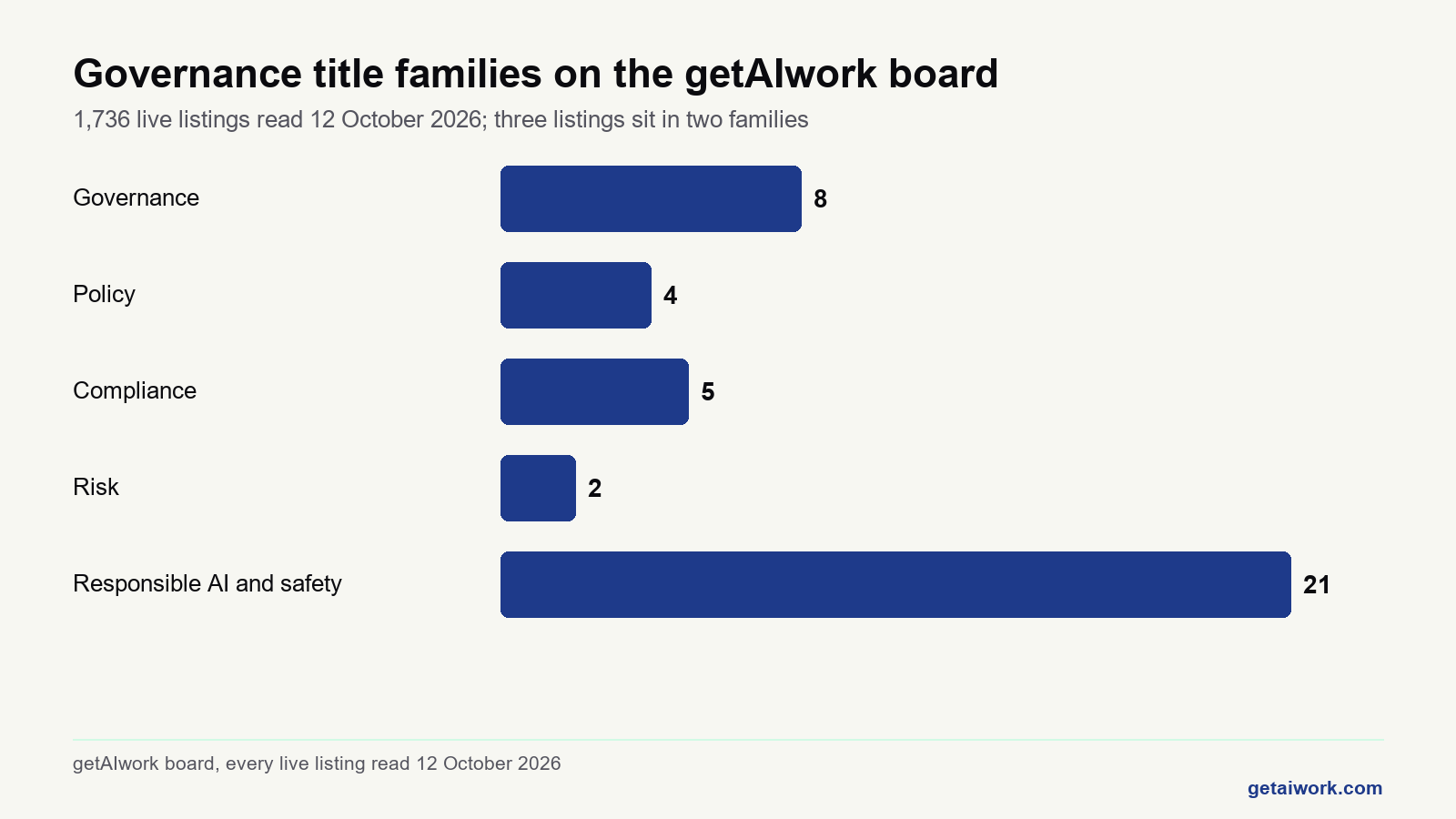
Thirty seven, if you count the way we counted. We read every one of the 1,736 live listings on the free, public getAIwork board on 12 October 2026 and kept each title that names governance, policy, compliance, risk or AI safety in the AI sense. That rules out a fire safety reviewer and an insurance policy administrator, both of which a keyword search would happily hand you. The board’s stats.json, updated 11 October 2026, shows the full board split: 1,106 advanced, 414 intermediate and 216 beginner listings. Not one of the 37 sits in the beginner column.
| Title family | Listings | Remote | Level | Listing pay |
|---|---|---|---|---|
| Governance (AI or data governance in the title) | 8 | 0 | 8 advanced | 5 of 8 |
| Policy (AI model policy, policy SME) | 4 | 0 | 4 intermediate | 3 of 4 |
| Compliance and regulatory | 5 | 3 | 5 advanced | 4 of 5 |
| Risk (AI risk in the title) | 2 | 1 | 2 advanced | 1 of 2 |
| Responsible AI, AI safety and trust and safety | 21 | 14 | 6 advanced, 15 intermediate | 19 of 21 |
| Unique listings | 37 | 17 | 19 advanced, 18 intermediate | 30 of 37 |
Three listings sit in two families at once, which is why the rows add to 40 and the total is 37. The shape matters more than the number. The eight governance titles are all senior, all on site or hybrid, and all in the United Kingdom, Germany or India: an AI Governance Lead at the RNLI in Poole, a Data and AI Governance Manager at Drax, two consultancy postings in Germany and a Responsible AI consultant at Bosch in India. The remote work lives almost entirely in the AI safety family, where Mercor, micro1 and AIUC list hourly contract roles evaluating model outputs and red teaming. Those are AI data jobs with a safety label, not committee work. Consultant is the most overloaded word in that list, and our count of AI consultant jobs across the board, Accenture and Capgemini shows how many different jobs it covers.
What do the AI governance postings actually ask for?
Experience in an adjacent control function, before anything else. The board text of the Trusteq AI Governance Consultant posting asks you to analyse existing governance models, design policies, procedures and frameworks, and set up committees and clear accountability structures. The AI Compliance and Security Engineer posting from FT Recruitment Group wants someone who can develop AI governance, security controls and responsible usage standards while working with IT, security, legal and data teams. Nobody is hiring a philosopher.

Here is the part the course adverts leave out. We searched the stored text of all 37 listings for the names of the rules themselves. The EU AI Act appears in none of them, ISO 42001 in none, and NIST in exactly one, the UK AI Security Institute’s Workstream Lead for agentic AI risk. The board stores a summary of each listing, so the full postings name more: when we followed the Bosch listing to its source, it named the EU AI Act twice, NIST four times, ISO 42001 twice and GDPR once, and asked for twelve years of experience. Six other source postings we could reach named no statute at all. Employers describe the work and expect you to know which law makes each piece necessary.
The responsible AI and safety family asks for something else again. The Mercor Compliance Officers listing wants licensed compliance professionals who can judge whether AI generated compliance content holds up against real regulations, and the micro1 Compliance Attorney listing wants licensed attorneys. The AI safety expert postings from Neon want a second language, English paired with Norwegian, Thai, Dutch or Malay, plus the stomach to read harmful content and label it. These are the only postings in the 37 open to someone without a governance background, and they are hourly contract work.
What the governance postings asked for
Tick what you can already show. Each line restates a requirement from the listings on the board on 12 October 2026, nothing more.
This list scores nothing and promises nothing. It is the listings’ own wording, read on 12 October 2026, and postings change.
Which rules do the postings expect you to know?
This section describes regulations and standards for general information. It is not legal advice. The dates come from the European Commission’s own AI Act page and NIST’s own framework page, read on 12 October 2026, and both can change.
Two documents come up in almost every governance conversation, and one standard. The European Commission’s AI Act page says the Act entered into force on 1 August 2024, that prohibited practices and AI literacy obligations applied from 2 February 2025, that general purpose AI model obligations applied from 2 August 2025, and that the Act became generally applicable on 2 August 2026 with exceptions. The exceptions are the whole job. The AI Omnibus, which the page says entered into force on 27 July 2026, pushed the high risk obligations for the sensitive use cases in Annex III to 2 December 2027, and for AI embedded in regulated products in Annex I to 2 August 2028. The page lists what a high risk provider must have: adequate risk assessment and mitigation systems, high quality datasets, detailed documentation, logging for traceability, appropriate human oversight measures and a post market monitoring system. That list is a governance job description with the salary removed.
| Document | Who publishes it | Status on 12 October 2026 | What a posting means by it |
|---|---|---|---|
| EU AI Act | European Union | In force since 1 August 2024; Annex III high risk duties apply from 2 December 2027, Annex I from 2 August 2028 | Risk classification, documentation, human oversight, conformity assessment |
| NIST AI RMF 1.0 | US National Institute of Standards and Technology | Released 26 January 2023, voluntary, being revised under the White House AI Action Plan; Generative AI Profile 26 July 2024 | Govern, Map, Measure, Manage: the four functions a programme is built around |
| ISO/IEC 42001 | ISO and IEC | Named in the Bosch posting and by forum accounts; the ISO site refused our reader twice, so we quote nobody on its text | An auditable AI management system, the thing a Lead Implementer course teaches |
NIST’s page describes its framework as intended for voluntary use, to improve the ability to incorporate trustworthiness considerations into AI products and to manage risks to individuals, organizations, and society. Voluntary is the word to hold on to: in the United States employers adopt NIST because a customer or a procurement team asked, while in the EU the Act is law, which is why five of the eight governance titles are in Britain, two in Germany, one in India and none in the United States. If you want to know which kind of AI work your own background reaches, the two minute match quiz sorts the salaried roles from the contract ones.
Do the AI labs hire for governance and policy?
Yes, and in larger numbers than the screened board, with a catch. We read Anthropic’s Greenhouse board and OpenAI’s Ashby board on 12 October 2026 and searched every title for governance, policy, compliance, risk, responsible, safety, trust, privacy, regulatory, alignment or ethics. Anthropic’s board held 645 open postings and 35 matched, among them a Policy Communications Manager for Responsible Scaling, Security and Governance posted 6 October 2026 and a Product Policy Manager for Product Risk posted 24 August 2026. OpenAI’s board held 811 postings and 48 matched, including a Research Program Manager, Governance posted 9 September 2026 and a Senior Product Policy Lead, Regulation posted 21 September 2026. For the safety side of those same boards, our count of AI safety jobs by role family sorts every safety titled posting at Anthropic, OpenAI and Google DeepMind and checks which ones ask for a PhD.
| Board, read 12 October 2026 | Open postings | Governance, policy, risk and safety titles | Where they sit |
|---|---|---|---|
| getAIwork screened board | 1,736 | 37 | UK 8, US 7, Germany 3, India 2, remote 17 |
| Anthropic, own board | 645 | 35 | San Francisco, New York, Washington DC, London; a few remote friendly |
| OpenAI, own board | 811 | 48 | San Francisco almost entirely; one London, one Singapore, one Dublin |
The catch is the one our Anthropic jobs count and OpenAI careers breakdown already found for every other function: the labs hire these roles as salaried staff in a handful of cities, and the policy titles sit beside words like Head, Lead, Manager and Counsel. Both lab counts have moved since we last read them, 623 to 645 at Anthropic since 25 September and 830 to 811 at OpenAI since 26 September, which is the usual churn and not a trend.
What do people already in AI governance report?
We read four threads in the r/AI_Governance subreddit, all from September and October 2026, holding about 44 comments between them. What follows is what people report, not evidence about the market, and every account is paraphrased.
The most upvoted answer in a September 2026 thread from a new Deloitte trainee came from someone working in the field, who said to read ISO 42001, the NIST AI RMF, the OECD AI Principles and the EU AI Act before anything else, to get exposure to risk, cyber and compliance projects where they already were, and not to switch roles after a month. Asked whether governance is just an extension of GRC, they said only the controls change. In a thread from 24 September 2026, a person with twenty years in cybersecurity described pivoting into AI engineering after a year of graduate courses and said plainly that AI governance is not something most companies will trust a fresher with. A thread from 4 September 2026 asked who actually holds an AI governance job; nobody who answered had the title, two said it was a side aspect of their work, and one said it is probably not a stand alone role in most organisations.
The accounts that cut against the optimism are the useful ones. In the thread by a poster who read 100 job descriptions in September 2026, one commenter who had just completed the IAPP’s AIGP wrote that they saw a lot of talk in the space but not much real work, and planned to add data quality and bias testing standards to stand out. A managed service provider in the same thread said governance had turned out to be a one time project for their clients, who would not pay for it on an ongoing basis. The original poster’s own count agreed with ours on the shape: risk and compliance dominate, policy writing is perhaps a fifth of the work, and no coding was required. Where the forum and the board disagree is on who gets hired. The forum says a certificate opens the door; the board’s 37 postings mention no certificate by name, and ask for experience instead.
What do AI governance jobs pay, as listed?
Written straight, because this is the part people spend money on. Every figure below is listed by the poster on the getAIwork board, read on 12 October 2026, or is marked as an aggregator estimate where the board marks it so. Rates change, offers change, and nothing here is a promise about what anyone will be paid.
| Listing on the board | Pay as the board shows it | Basis | Remote |
|---|---|---|---|
| AI Governance Lead, RNLI (UK) | £42,479 to £49,976 a year, as listed | Permanent, full time, hybrid Poole | No |
| Product and Propositions Manager, AI Governance, Bulb Resourcing (UK) | £85,000 a year, as listed | Consultancy, UK | No |
| Principal Consultant, AI Security and Governance, Fruition Group (UK) | £116,809 a year, aggregator estimate | Leeds, hybrid | No |
| Compliance Attorney, micro1 | $100 to $180 an hour, as listed | Contract, licensed attorneys, 50 openings stated | Yes |
| Compliance Officers, Mercor | $70 to $110 an hour, as listed | Contract, licensed compliance background | Yes |
| AI Safety Red Teamer, AIUC via Mercor | $70 to $84 an hour, as listed | Contract, intermediate | Yes |
| AI Safety Experts, English and Dutch, Neon via Mercor | $48 to $62 an hour, as listed | Contract, intermediate | Yes |
| AI Safety Experts, English and Indonesian, Neon via Mercor | $17 to $25 an hour, as listed | Contract, intermediate | Yes |
Two things stand out. The salaried governance roles that list pay are British, and the listed figures run from a charity’s £42,479 to a consultancy’s £85,000, with the higher numbers on the board being aggregator estimates rather than the employer’s own words. The remote figures are all hourly contract rates for licensed or bilingual specialists, and the Neon safety postings pay by language pair, from $17 an hour for Indonesian and Vietnamese to $62 for the Nordic languages and Dutch, as listed on the same day. Seven of the 37 listed no pay at all, including every German posting and the AI Security Institute role.
How do you get in from a non technical background?
Through the control function you already know, which is what the postings and the forum both say. The board’s own split makes the routes concrete.
| Your background | The family that reads your CV | What the postings ask for | Where to look first |
|---|---|---|---|
| Risk, audit, compliance or GRC | Governance, compliance, risk | Framework design, policies, committees, control testing | Licensed profession listings on the board |
| Privacy or data protection | Governance, privacy counsel | GDPR practice, impact assessments, data governance | AI data work listings on the board |
| Licensed lawyer or compliance officer | Compliance platform work | Judging AI outputs against real regulations, hourly | Mercor Compliance Officers |
| Fluent in English and a second language | AI safety contract work | Reading and labelling harmful content, hourly | Neon AI Safety Experts |
| No control function experience yet | None of the 37 today | The postings ask for experience first | AI training jobs with no experience |

On certificates, the honest reading of the IAPP’s own AIGP page is that it describes the credential as demonstrating competency in AI development, ethical deployment and AI management best practice, and makes no claim at all about jobs, salaries or employer recognition. The course sellers who resell it are less restrained. The adverts promising a governance career after a weekend of videos are selling a credential the board’s 37 postings do not mention. Read the four frameworks the forum names, which are free, then go looking for the control work that already exists where you work; that is the route the people with the jobs describe. Our guide to AI certification for non technical roles covers which certificates employers actually ask for, and the highest paying AI jobs breakdown shows where governance sits against engineering, pay only as listed.
Before you pay for anything, the match quiz takes two minutes and tells you whether a salaried governance role or hourly compliance evaluation work fits what you can show today, and the work board is free and public, with no signup, so you can watch the governance titles come and go yourself.
Frequently asked questions
Is AI governance an entry level job?
Not on the board we read. None of the 37 governance, policy, compliance, risk or AI safety listings on 12 October 2026 was marked beginner, and the governance titles were all senior. People in the field on r/AI_Governance say the same: it is a move from risk, compliance, privacy or security, not a first job.
Do AI governance jobs require coding?
The postings we read do not ask for it. They ask for policy writing, risk classification, documentation, audit and framework design. A poster who read 100 descriptions in September 2026 reported no coding requirement either. The hourly AI safety evaluation roles want a second language rather than code.
Does the EU AI Act already apply to high risk systems?
Not yet. The European Commission’s AI Act page, read on 12 October 2026, says the AI Omnibus moved the Annex III high risk obligations to 2 December 2027 and the Annex I obligations to 2 August 2028, while prohibitions, AI literacy, general purpose AI rules and transparency duties already apply.
Is the NIST AI RMF mandatory in the United States?
No. NIST describes the framework as intended for voluntary use. Its four functions, Govern, Map, Measure and Manage, are what US employers mean when a posting says they are building an AI risk programme, and NIST says version 1.0 is being revised under the White House AI Action Plan.
Are the remote AI governance jobs real governance roles?
Mostly not. Of the 17 remote listings, 14 were AI safety or responsible AI contract postings from Mercor, micro1, AIUC and Neon, paid by the hour to evaluate and red team model outputs. Three remote compliance postings asked for licensed compliance officers or attorneys. The eight governance titled roles were all on site or hybrid.
Will the AIGP certificate get me an AI governance job?
The IAPP’s own AIGP page makes no claim about jobs or employer recognition, and none of the 37 board postings named it or any certificate. One forum account from a new AIGP holder in September 2026 reported little real work behind the talk. Experience in a control function is what the postings ask for.
Finished the page? The same five questions from the top, to see what stuck.
Watch the 41 second summary
The video covers the takeaways of this guide in under a minute. More summaries are on getAIwork on YouTube.
Platform statuses and listed pay change without notice. Pay figures are quoted only as listed by the poster on the date shown and are never a promise of earnings. This page was verified on the date shown and is rechecked on the weekly refresh.