
AI trainer jobs are contract or hourly roles where people write, rate and correct AI model answers against a written standard. On postings read 28 September 2026, xAI listed US AI tutors at $35 to $75 an hour, yet only 25 of 1,720 listings on our board used the word trainer in the title at all.
Listen to this article, about 15 minutes. A synthetic voice reads the article and announces each section title as it begins; tables are read row by row and the questions at the end are left out.
Recorded 2 October 2026 from the article as published that day. Press a chapter to jump there; the highlighted line is what is playing. A play button sits beside every section heading, and once you scroll past this player a bar at the bottom of the screen keeps the controls in reach. Tap or click any sentence to hear the reading start from there.
On this page: six vendors’ AI trainer postings read on 28 September 2026 with pay as listed, a count of the words 1,720 real board listings use instead of trainer, and 16 dated reviews from applicants.
Think you already know this? Five questions, one minute.
Every answer is on this page. Answer from what you know now; the page fills in the rest.
-
1. How does xAI’s humanities tutor posting describe the work?
The posting says the work is grounded in scholarly judgment, not creative writing, per xAI’s AI Tutor posting. Read the section
-
2. On the board crawl of 27 September 2026, which word appeared most often in listing titles?
Expert appeared in 281 titles against 25 for trainer, counted from the getAIwork board. Read the section
-
3. What US pay range did xAI list for its AI Tutor role on 28 September 2026?
US based candidates were listed at $35 to $75 an hour, with international pay given during recruitment, per the xAI posting. Rates change and are not guaranteed. Read the section
-
4. What does an AI rater mainly produce, as the page sorts the labels?
Raters score and rank answers, while trainers write answers and rubrics; Outlier lists rating and ranking answers as one task among several. Read the section
-
5. How long does Outlier say its onboarding typically takes?
Outlier’s own page says onboarding typically takes 30 to 90 minutes; it gives no time for the wait for a first project, per Outlier. Read the section
What does AI trainer mean on an actual job posting?
Strip away the advert copy and every vendor describes the same core job: judge what a model said against a standard, then show it something better. DataAnnotation lists the tasks as “reviewing responses, checking accuracy, refining prompts, and rating outputs.” Outlier names three: write a challenging prompt, create grading rubrics, and rate and rank answers.
The expert end of the market asks for more judgment and less clicking. xAI’s AI Tutor, Humanities posting, updated 24 September 2026, wants people to evaluate model outputs for factual accuracy and hidden assumptions, flag confident sounding errors, and write exemplary responses grounded in primary sources. It adds that the work is “grounded in scholarly judgment, not creative writing.” Handshake AI’s AI Model Policy Trainer, Generalist role reads conversations, decides which customer policy category applies, and writes a rationale another person could audit. Nobody, it turns out, is teaching a robot to ride a bicycle. The job is closer to marking essays with a very detailed rubric and a very fussy head of department.
How often do real postings use the word trainer?
Rarely, which surprised me. I run the getAIwork work board, which screens AI work listings by hand every day, and a crawl of the public board on 27 September 2026 captured 1,720 listings. Counting the words in their titles shows the gap between the advert vocabulary and the posting vocabulary. A title can contain more than one of these words, so the rows overlap.
| Word in the listing title | Listings on 27 Sep 2026 | Most frequent posters |
|---|---|---|
| expert | 281 | Mercor (119), micro1 (90) |
| specialist | 100 | Mercor (28), micro1 (26) |
| annotator or annotation | 45 | Neon (6), YO AI Labs (5) |
| evaluator or evaluation | 32 | Mercor (11), micro1 (6) |
| trainer | 25 | Welo Global, Anyone Ai and micro1 (4 each) |
| rater or rating | 12 | Welo Global (11) |
| tutor | 2 | micro1, Duolingo (1 each) |
So the word the adverts shout is trainer, and the word the postings use is expert, eleven times as often. One of the 25 trainer titles is not AI training at all: Anthropic’s GTM Enablement Trainer trains sales staff on Claude products. Among the rest, listed pay ran from $10 to $20 an hour on a micro1 Robotics Data Trainer listing to $100 to $180 an hour on a micro1 listing titled simply AI trainer, as listed on 27 September 2026. Across the whole board that day, generalist and writing listings carried a median listed rate of $63 an hour over 214 listings, and language listings $36 over 132, per the board’s published statistics. Those are listed figures, rates change, and nothing is guaranteed. If a search for trainer turns up little, searching for expert, evaluator and specialist finds the same kind of work under the names vendors actually use. Generalist is a similar story: on real postings it names two unrelated jobs, which our page on what AI generalist means on real postings sorts apart.
If you would rather not read 1,700 titles to find the handful that match your background, the AI trainer match quiz asks a few questions and points you at the platforms whose entry rules fit.
Who is hiring AI trainers now, and what do they list?
These are the postings and vendor pages read on 28 September 2026. Pay is shown exactly as each vendor listed it; none of it is a promise, and the same page can say something different next week.
| Vendor | Title on the posting | Listed pay (source, date) | The gate | Arrangement |
|---|---|---|---|---|
| xAI | AI Tutor, 24 open postings (languages, humanities, writing, video, software, legal) | US: $35 to $75 an hour; international: given during recruitment (xAI posting, 28 Sep 2026) | Deep field knowledge; PhD preferred for humanities; no hires in Wyoming or Illinois; no visa sponsorship | Full time, part time or contractor; remote worldwide subject to eligibility |
| Handshake AI | AI Model Policy Trainer, Generalist | $30 to $85 an hour (Ashby posting, published 28 Aug 2026) | Policy judgment; regular exposure to sensitive content | Onsite Seattle, 40 hours, W2 through TCWGlobal |
| DataAnnotation | No single title; “teach AI your expertise” | General $25 to $50, coding $40 to $150+, professional $40 to $125+, language $25 to $40 an hour (homepage, 28 Sep 2026) | Apply, then qualify through an assessment | Remote contract |
| Outlier | AI trainers and experts | No rate on the homepage; “competitive pay + quality-based rewards, paid weekly” (28 Sep 2026) | ID and phone from your country, resume, LinkedIn, identity and skill checks | Remote contract, about 50 countries per its site |
| Alignerr | Role by role | Roles shown from $30 to $35 up to $40 to $120 an hour (homepage, 28 Sep 2026) | PhDs, researchers, subject experts; native speakers for language roles | Remote contract |
| Meridial by Invisible | Expert contractor | Not published; rates confirmed before a project starts (28 Sep 2026) | Domain experts in law, STEM, finance, coding, linguistics, safety | Project based independent contractor |
Two things stand out. The listed ranges are wide because the vendor prices the field, not the title: DataAnnotation lists its general tier from $25 an hour and its coding tier from $40. And the arrangement varies more than the pay. xAI says most contractor projects may involve at least 10 hours a week with no fixed commitment, while the Handshake role is a fixed 40 hour week, paid hourly and eligible for overtime. Our reviews of Handshake AI and Alignerr go deeper on each, and the data annotation platforms compared page sets the generalist platforms side by side.
Which AI trainer role family matches what you already have?
Pick the line closest to your background. Each result restates the vendor table on this page, as listed on 28 September 2026.
This restates the page’s table and is not a prediction of acceptance or pay. Listed rates change and nothing is guaranteed.
How is an AI trainer different from a rater or annotator?
Mostly by what you hand over at the end of a task. Vendors use these labels loosely, and one project can mix all four, but the postings above sort roughly like this.
| Label | What you produce | Typical gate | Seen on a real posting |
|---|---|---|---|
| AI trainer or tutor | Written answers, critiques and grading rubrics | Field test or interview | xAI AI Tutor; Outlier |
| AI rater | Scores and rankings of model answers or search results | Guidelines exam | Welo Global, 11 rater titles on 27 Sep |
| Annotator | Labels on text, images, audio or video | Short task test | Neon, YO AI Labs |
| Policy trainer or evaluator | A category decision plus a written rationale | Judgment assessment | Handshake AI, Mercor |
The trainer label usually means writing is involved, which is why the expert roles cluster there. Rating work is covered in our guide to AI rater jobs, and the preference ranking behind reinforcement learning has its own page on RLHF jobs.

What happens between applying and the first paid task?
On the platforms, a sequence that looks short on paper. Outlier’s own page lists four steps, create a profile, import and review skills, verify identity, verify skills, and says onboarding typically takes 30 to 90 minutes. DataAnnotation compresses it to apply, qualify, work. What neither page gives is a time for the step after the test, when you wait to be matched to a project, and that is where most complaints collect. Our walkthrough of the DataAnnotation Starter Assessment covers the test itself.

The two employer postings run a conventional hiring process instead: xAI says role details come during the interview process, and the Handshake role is employment through a staffing firm, TCWGlobal, on a W2. That difference matters at tax time. This is not tax or legal advice: the IRS explains how employees and independent contractors differ, and a qualified adviser can say which applies to a given arrangement.
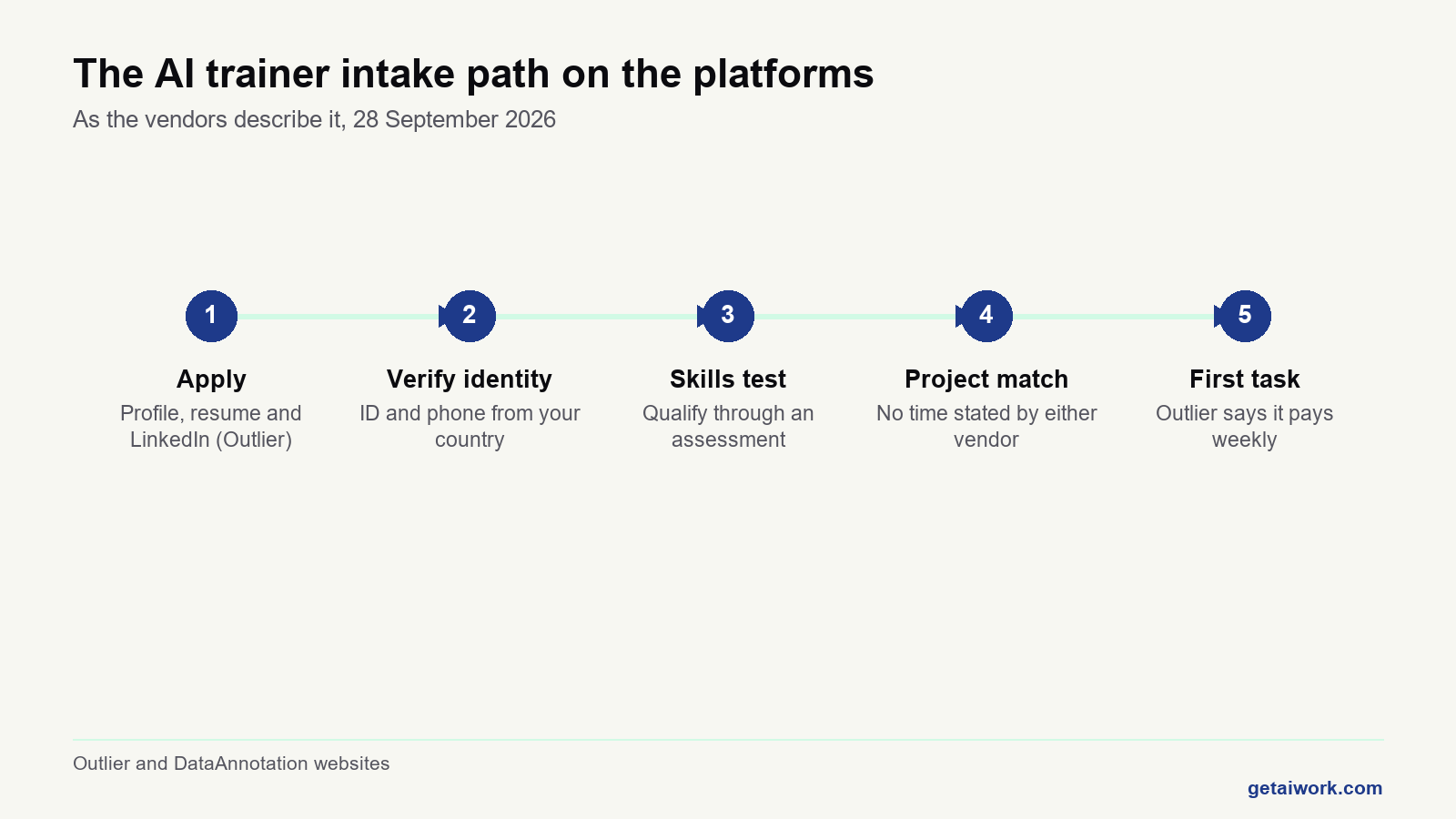
What do people who applied actually report?
I read the 16 most recent reviews on Trustpilot for two platforms on 28 September 2026, eight each, dated between 12 August and 27 September 2026. These are what reviewers report, not findings, and recent reviews lean towards people with a problem to post about. Outlier held a TrustScore of 4.1 from 5,290 reviews; DataAnnotation held 3.9 from 1,968.
The Outlier sample split evenly. Four five star reviews from 22 to 27 September praised reliable payments and clear tasks, one noting that task availability varies. Against that, a 27 September reviewer who applied for Chinese voice work said they were placed on a different project with lower pay than advertised, another described an account stuck in an empty queue after a similarity flag they blamed on a glitched onboarding, and a four star reviewer on 22 September liked the workflow but reported a deactivation with no explanation.
The DataAnnotation sample was harsher: six of eight were one star. Reviewers on 18 and 26 September described months with no response or no projects after applying, one on 25 September said they kept repeating a qualification test without moving forward, and one on 17 September said the bilingual assessment was not offered in their language. A 2 September reviewer alleged an account locked with earnings frozen, which is the reviewer’s allegation and not verified here. The one four star review enjoyed the work but reported droughts lasting months.
Where the accounts agree with the vendors: the first onboarding step really is short. Where they do not: neither vendor page mentions the wait for a first project, and it is the single most repeated complaint. Our pages on DataAnnotation not responding and Outlier alternatives cover what applicants try next.
How do you tell a real AI trainer posting from a fake one?
Real postings live on the vendor’s own board or careers page, as every row in the table above does, and they list pay as a range with a location attached. The fake ones arrive in a Telegram or WhatsApp message from a so called recruiter claiming to hire for OpenAI, a company whose real openings sit on its own careers board, as our OpenAI careers page shows. The tell is money flowing the wrong way: a fee for a training kit, a deposit to unlock tasks, or a certificate no employer on this page asked for. The FTC has documented this pattern of task scams that make people pay to get paid.
None of the six vendor pages read for this article mentions a fee to apply or asks for a course certificate. The safest place to start is the free public work board, which links each listing to the vendor’s own page and needs no signup, and the paid AI training quiz narrows the list to the platforms that accept someone with your background. Listed rates change, and nothing on any of these pages is guaranteed.
Frequently asked questions
Do AI trainer jobs need a degree?
It depends on the tier. xAI’s humanities tutor posting prefers a PhD or equivalent scholarly depth, and Alignerr names PhDs and researchers. DataAnnotation’s homepage lists a general tier beside its professional ones and, on 28 September 2026, named no degree for it.
Are AI trainer jobs remote?
Most platform roles are, but not all. The Handshake AI policy trainer role read for this page is onsite in Seattle. Across the whole getAIwork board, 615 of 1,709 live listings were tagged remote on 27 September 2026.
Is AI trainer work full time?
Usually not. Platform work arrives by project with no fixed hours, and xAI says its contractor projects may average at least 10 hours a week with no fixed commitment. The Handshake role is the exception, a 40 hour week on a W2.
Can people in India apply for AI trainer jobs?
Some vendors accept applicants there. xAI says tutor roles can be done remotely from anywhere subject to legal eligibility, though its posting gives international pay only during recruitment. Outlier says it operates in about 50 countries and needs ID and a phone from your country of residence.
Is an AI trainer the same as a prompt engineer?
No. A prompt engineer designs prompts to get useful output from a model inside a product. An AI trainer produces judgments, answers and rubrics that are used to improve the model itself.
Do I need to pay for an AI trainer course or certificate?
None of the six vendor pages read for this article asked for one or mentioned a fee to apply. A request for money before work starts is the most reliable sign that a so called AI trainer offer is not real.
Finished the page? The same five questions from the top, to see what stuck.
Platform statuses and listed pay change without notice. Pay figures are quoted only as listed by the poster on the date shown and are never a promise of earnings. This page was verified on the date shown and is rechecked on the weekly refresh.