
AI safety jobs numbered 640 on the 80,000 Hours job board on 19 October 2026, up from 110 in a May 2023 count. Across the Anthropic, OpenAI and Google DeepMind boards, 96 roles carry safety in the title, and not one demands a PhD without an equivalent experience route. Entry level openings are still scarce.
Listen to this article, about 12 minutes. A synthetic voice reads the article and announces each section title as it begins; tables are read row by row and the questions at the end are left out.
Recorded 19 October 2026 from the article as published that day. Press a chapter to jump there; the highlighted line is what is playing. A play button sits beside every section heading, and once you scroll past this player a bar at the bottom of the screen keeps the controls in reach. Tap or click any sentence to hear the reading start from there.
On this page: the May 2023 count of AI safety jobs redone on 19 October 2026 across the 80,000 Hours board and the Anthropic, OpenAI and Google DeepMind boards, sorted by role family, with the PhD line read on every lab posting and what about 30 applicant comments report.
Think you already know this? Five questions, one minute.
Every answer is on this page. Answer from what you know now; the page fills in the rest.
-
1. How many roles carried the AI safety and policy tag on the 80,000 Hours board on 19 October 2026?
640 roles carried the tag, 550 of them full time. 110 is the May 2023 figure as reported, and 96 is the safety titled count across the three lab boards. Source: 80,000 Hours job board Read the section
-
2. What was the largest single group of safety titled postings at Anthropic on 19 October 2026?
Ten Safeguards Enforcement Analyst postings were open, each covering one harm area, and they ask for trust and safety or policy enforcement experience. Source: Anthropic’s Greenhouse board Read the section
-
3. How many of the 96 safety titled lab postings required a PhD with no equivalent experience alternative?
None did. Four DeepMind postings list a PhD or equivalent practical experience, and one sets a master’s or PhD as the floor. Source: Google Careers, filtered to DeepMind Read the section
-
4. How long does Anthropic’s Fellows Program in AI safety and security run, as listed on 19 October 2026?
The posting describes four months of full time research at about 40 hours a week, with a weekly stipend as listed. Source: Anthropic Fellows Program posting Read the section
-
5. How many of the 640 safety and policy roles on the 80,000 Hours board were tagged remote on 19 October 2026?
165 carried the remote tag and 116 were tagged as open globally; most lab postings named an office city. Source: 80,000 Hours job board Read the section
How many AI safety jobs are open right now?
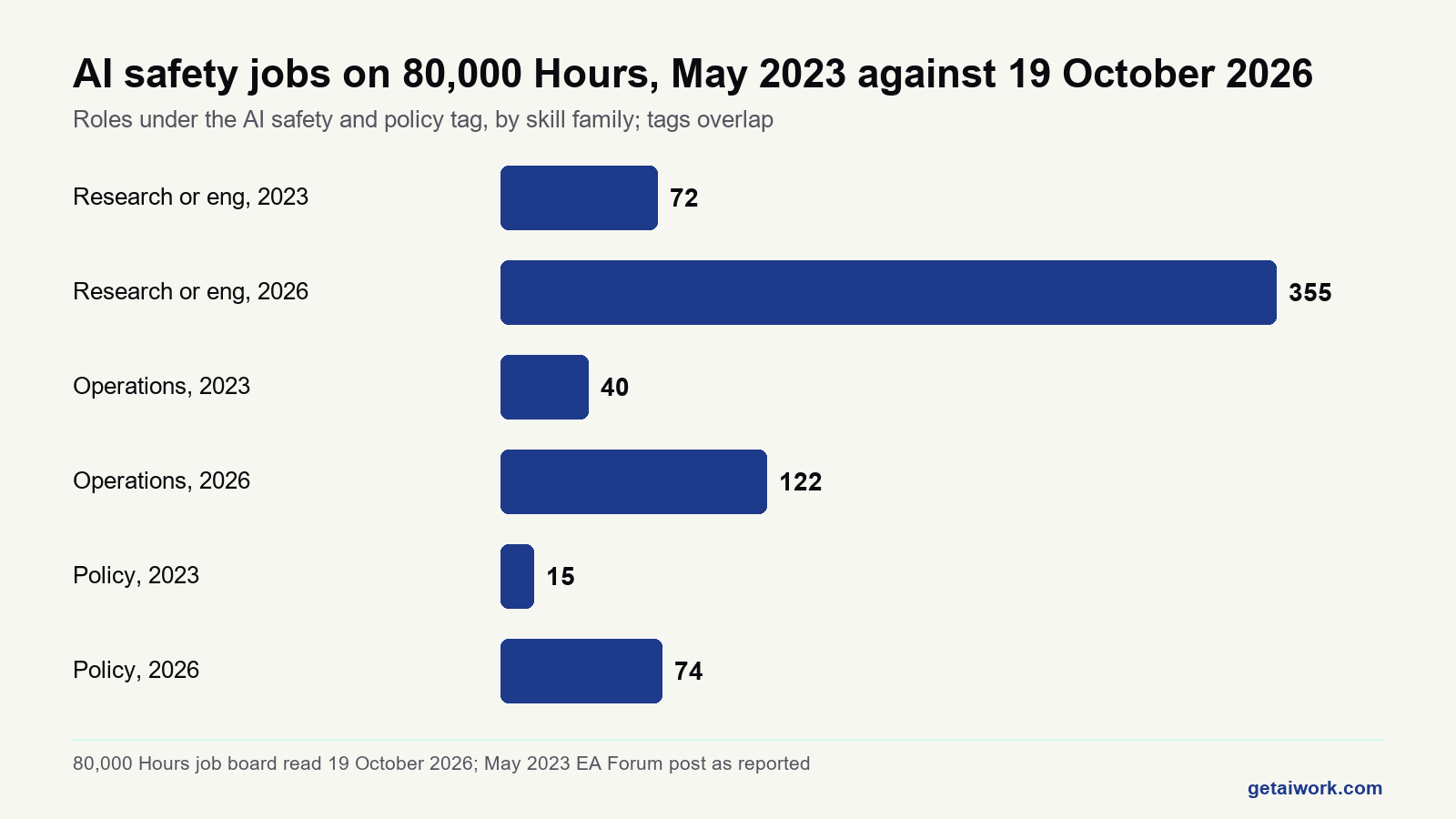
The only public count most searchers find is three years old. A May 2023 EA Forum post reported 110 roles under the AI safety and policy filter of the 80,000 Hours board. When that post was opened on 19 October 2026 its body no longer loaded, so its figures here are as quoted in search results and are unverified at the source. Redoing the count on the same board on 19 October 2026 gives 640 roles under the same tag, 550 of them full time. The 2023 post split its roles as 72 in research or software engineering, 40 in operations and 15 in policy, with tags overlapping; the same split today is 355, 122 and 74.
The three labs everyone searches for were read from their own boards the same day. A posting counts as a safety role when its title names safety, safeguards, alignment, interpretability, red teaming, preparedness, responsibility, frontier risk or the Frontier Safety Framework. That rule is strict, so plenty of security and policy jobs that help with safety are left out, which keeps the numbers honest rather than flattering.
| Board, read 19 October 2026 | Safety roles | Research or engineering | Operations, product, enforcement | Policy | Hard PhD minimum |
|---|---|---|---|---|---|
| Anthropic, Greenhouse | 42 of 656 | 19 | 22 | 1 | 0 |
| OpenAI, Ashby | 37 of 813 | 21 | 14 | 2 | 0 |
| Google DeepMind, Google Careers | 17 of 111 | 10 | 7 | 0 | 0 |
| 80,000 Hours, AI safety and policy tag | 640 | 355 | 122 | 74 | 41 tagged doctoral |
Two cautions about that table. The 80,000 Hours board already lists many lab roles, 35 from Anthropic, 24 from OpenAI and 17 from Google DeepMind on the day, so the rows must not be added together. And the board tags one job with several skills, which is why its families add up to more than 640, exactly as the 2023 split did.
What kinds of work do AI safety jobs actually involve?
Less of it is research than the name suggests. At Anthropic, the largest single group was 10 Safeguards Enforcement Analyst postings, each covering one harm area such as child safety, cyber harm or conventional weapons. These are operational jobs: the Safety Evaluations analyst posting asks for experience in trust and safety, content operations or policy enforcement, and lists $230,000 to $270,000 as of 19 October 2026.
Research is the smaller and steeper door. Anthropic’s Research Engineer or Scientist, Alignment posting listed $350,000 to $500,000 on the same day, and its Red Team Engineer, Safeguards posting listed $320,000 to $405,000. At OpenAI the Alignment Interpretability researcher role listed $295,000 to $500,000 and asked for two or more years of research engineering. These are listed figures for specific postings in the United States; rates change and nothing here is guaranteed.
Policy is the thinnest slice at the labs, three postings across all three boards, but it is the family that grew fastest on 80,000 Hours, from 15 to 74 tagged roles. If governance is your interest, our page on what AI governance jobs ask for goes deeper on that side.
Which AI safety role family matches your background?
Pick the background closest to yours to see which family the boards showed hiring for it on 19 October 2026. This restates the article’s table; it does not estimate pay or your chances.
Figures read from the boards on 19 October 2026. Listings change weekly.
Do you need a PhD for an AI safety job?
On paper, almost never. Of the 96 safety titled lab postings read on 19 October 2026, Anthropic’s 42 never mention a PhD at all; its postings set the minimum as a bachelor’s degree or an equivalent combination of education, training and experience. OpenAI mentions a PhD once in 37, written as a PhD or equivalent research experience.
Google DeepMind is the most explicit. Four of its 17 safety postings list a PhD first in the minimum qualifications, each followed by the words or equivalent practical experience. One posting, the Research Engineer, Responsible Frontier AI Research, sets a master’s degree or PhD as the minimum with no alternative, the only hard graduate degree floor in the whole count. Its AGI Safety and Alignment research scientist posting asks only for a bachelor’s degree or equivalent and three years in software, ML engineering or research.
The 80,000 Hours tags tell the same story from a wider sample: 41 of the 640 roles were tagged as needing a doctoral degree, 38 of them research roles, and 559 as needing an undergraduate degree or less. The catch is the phrase equivalent experience, which in research usually means published or shipped work that someone can read. A certificate from a weekend course does not count, whatever its sales page says.

Are there entry level AI safety jobs?
A few, and the growth skipped them. The 2023 post reported 28 entry level research or software roles in the United States. On 19 October 2026 the board tagged 23 research or software engineering roles as entry level with a US location, fewer than before, while the total grew almost sixfold. Across every family, 74 of the 640 roles carried the entry level tag.
Fellowships fill the gap that entry level hiring leaves. Anthropic’s Fellows Program, AI Safety and Security runs four months full time and lists a weekly stipend of 3,850 USD, 2,310 GBP or 4,300 CAD as of 19 October 2026, for people with a strong technical background who want to move into empirical research. Programs such as MATS play the same role across the wider field. If you are earlier than that, our page on AI jobs for freshers covers the roles that do hire without experience.
Not sure which family fits your background? The two minute match quiz sorts that out before you spend an evening on a cover letter.
What do people applying for AI safety roles report?
This count drew on about 30 comments across four Reddit threads from July to September 2026. These are what people report, not verified outcomes, and they are paraphrased here.
In the r/csMajors thread on the MATS autumn 2026 cohort, opened in July 2026, several people reported rejections from every stream they had applied to, some arriving on the same day. One applicant said a main conference paper at ICML had not been enough, and another objected to being asked for references before any interview. A few people were sent written work tests or interviews instead.
A September 2026 comment in r/slatestarcodex described fellowships as the main path for software engineers moving into alignment, with paid ones so competitive that an unpaid one can be easier to land first; the writer said they had been rejected by several.
In r/AIsafety in July 2026, an Indian computer science student asked whether the field was out of reach, since most openings looked aimed at international candidates. One reply, from someone who said they work in AI governance, pointed to a master’s or PhD for lab research and noted that labs often sponsor visas. Another, from a self described red team project lead in August 2026, argued that security, red teaming and evaluations hire more widely and more remotely than alignment research.
On the contract side, a September 2026 thread in r/mercor_ai started with a poster who had finished a work trial for an AI safety project and received no offer; others replied that they were still waiting, one after being paid for the trial. The accounts agree with the boards on one point: the PhD is rarely the wall. Where they differ is tone, because the boards say equivalent experience and the applicants report that the experience has to be visible work.
Can you work on AI safety remotely or from India?
Remotely, sometimes; from India, rarely through the labs. On 19 October 2026 the 80,000 Hours board tagged 165 of its 640 safety and policy roles as remote, and 116 as open globally. The lab boards are far more office bound: most safety postings named San Francisco, New York, Seattle, Washington or London, and one OpenAI Cyber Operations Strategist role was listed as Ontario remote at CA$140,000 to CA$188,000 as listed, asking for eight or more years of offensive security work.
The nearer route for most readers is contract evaluation and red teaming work on AI training platforms. Our own board, which is free and public at getaiwork.com/board, showed 1,703 live listings in its stats file dated 18 October 2026, 536 of them on AI training platforms and 214 marked beginner. That work is not a lab job, and pay on it is set per project, so read our Mercor review before you assume a work trial leads anywhere.
If the only recruiter offering you a safety role writes on Telegram and wants a training fee first, it is not one of the lab boards above, where every role in this count is applied for directly on the employer’s own page.

Where should you look for AI safety jobs first?
Go to the source. Each lab’s own board shows the real titles, dates and listed pay, and our pages on Anthropic jobs, OpenAI careers and Google DeepMind jobs read each one in full. The 80,000 Hours board is the widest single list for non profits, research groups and government roles, and its degree and experience filters do the screening this article did by hand.
Before you apply, the match quiz can tell you whether a salaried safety role or contract evaluation work fits your background now, and the free work board lists contract AI work by country every day, with no signup.
Frequently asked questions
Does AI safety work pay well?
Listed pay at the labs is high: on 19 October 2026 Anthropic’s safety analyst postings listed $230,000 to $285,000 and its alignment research posting $350,000 to $500,000. These are listed US ranges for specific roles; rates change and nothing is guaranteed.
Is AI safety the same as trust and safety?
Not quite. Trust and safety enforces rules on how people use a product, while alignment research studies the model itself. At Anthropic both sit under safeguards, and the enforcement analyst roles outnumber research ones.
Which degree subjects do AI safety postings ask for?
Computer science dominates, but Google DeepMind’s risk modeling posting accepts a PhD in economics, philosophy or a STEM subject, or equivalent practical experience, on 19 October 2026.
Do AI safety jobs sponsor visas?
Some do. The 80,000 Hours board tagged 118 of its AI safety roles as US with confirmed visas and 47 as UK with confirmed visas on 19 October 2026. Check each posting, because the tag is the board’s, not the employer’s.
How long does an AI safety fellowship last?
Anthropic’s Fellows Program runs four months full time at 40 hours a week, as listed on 19 October 2026. Other fellowships set their own terms.
Is an AI safety certificate worth buying?
None of the 96 lab postings read on 19 October 2026 asked for one. They asked for degrees or equivalent experience, which in practice means work someone can read.
Finished the page? The same five questions from the top, to see what stuck.
Platform statuses and listed pay change without notice. Pay figures are quoted only as listed by the poster on the date shown and are never a promise of earnings. This page was verified on the date shown and is rechecked on the weekly refresh.